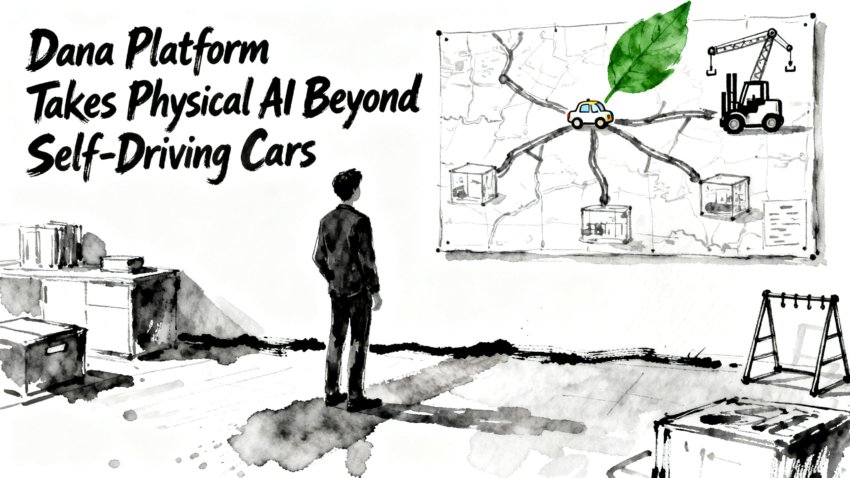
Dana Platform Takes Physical AI Beyond Self-Driving Cars
Applied Intuition Dana: A Decade of Autonomy Tooling Turned Into One Agentic Platform
Applied Intuition launched Dana in July 2026 as an agentic platform for building, testing, deploying, and operating physical AI systems, according to the company’s launch announcement. Dana packages the validation discipline of autonomy engineering into one reusable environment that extends its reach well beyond self-driving cars.
Applied Intuition has built simulation, data, and testing infrastructure for vehicle programs since its 2017 founding, per its Wikipedia entry and engineering posts. Co-founder and CTO Peter Ludwig describes Dana as that decade of infrastructure, tools, and workflows made agent-operable. This guide covers what the platform does, where it applies, and how engineering leaders should evaluate it.
TL;DR
Dana, launched by Applied Intuition, turns a decade of autonomy tooling into one agentic environment for physical AI: data curation, agent-run engineering workflows, and evaluation insights in a single governed system. Its reach extends from vehicles and fleets to robotics, construction, and mining, with traceability built in for safety-critical deployments.
Quick Takeaways
- Autonomy infrastructure is becoming a product: Dana turns a decade of simulation, data, and validation tooling into an agentic platform any machine-building team can adopt.
- Three core stages carry the workflow: data curation, agent-orchestrated engineering jobs, and a shared insights layer with full lineage.
- Target markets reach past cars into robotics, construction, mining, trucking, agriculture, defense, and intelligent in-vehicle experiences.
- Evaluation, traceability, and governance, not raw model quality, are what separate Dana from general-purpose AI assistants.
- The practical move for practitioners is a toolchain fragmentation audit before piloting any agentic platform.
What Is Applied Intuition Dana?
Dana is Applied Intuition’s agentic platform for physical AI, described in the launch announcement as rapid application development built on nearly ten years of autonomy tooling.
Agentic carries a specific meaning inside Dana. The agents execute engineering work rather than just answering questions: they can read requirements, run simulation jobs, evaluate results, and prepare deployment steps, with humans setting the checkpoints. Developers reach Dana through natural language, APIs, SDKs, custom applications, and embedded interfaces, and Dana connects to collaboration tools such as Slack and Jira, according to the company’s launch blog post.
The Dana product page splits the platform into three tracks: Dana for Physical AI, covering autonomy development; Dana for Software-Defined Vehicles, covering operating systems, middleware, and intelligent cabin experiences; and Dana for Fleet Operations, covering deployment, coordination, monitoring, and optimization of autonomous vehicles, robots, and industrial equipment.
Reference applications ship for autonomy and fleet operations, and organizations can build their own on top.
Did You Know?
Applied Intuition’s first product was a motion simulator that let autonomous vehicle developers reproduce and study problems in simulation instead of road-testing them, according to the company’s Wikipedia entry. That origin explains the platform DNA: prove it in simulation first, then take it to the physical world.
Why Physical AI Has Expanded Beyond Self-Driving Cars
Self-driving cars were physical AI’s original proving ground, and the problems that slowed those programs, sensor data management, simulation coverage, safety cases, and traceability, are the same ones now slowing robotics, mining, construction, and fleet deployments.
Autonomy programs paid for those lessons over decades. The documented history of self-driving vehicle development on Wikipedia runs from academic prototypes in the late 1970s, through government grand challenges and years of validation debate, to the first commercial robotaxi services. Capability tracked testing and validation practice far more than individual model breakthroughs.
The alternative to inherited autonomy discipline is toolchain fragmentation. In many industrial deployments, perception models live in one tool, simulation in another, and deployment scripts in a third, so no one can reconstruct why a machine behaved a certain way in the field. That audit gap is a real blocker in regulated, insurance-heavy sectors, and closing it is the design goal behind Dana’s unified workflow.
Core Capabilities of the Dana Platform
Dana organizes physical AI development around three core stages: data, workflows, and insights. Every result stays traceable with full lineage across the workflow, according to Applied Intuition’s launch blog post.
The data stage lets engineers ingest and validate sensor data or work with production-ready datasets, filtering by events of interest, map location, or data-quality metrics before anything reaches training or simulation. The workflow stage is where agents do the heavy lifting: running inference on autonomy models, evaluating regressions through open-loop replay, reconstructing real-world scenes for closed-loop neural simulation, generating adversarial behaviors with reinforcement learning agents, and using world models to vary weather, lighting, and environmental conditions.
The insights stage pulls results into a shared metrics and analysis layer, where developers compare autonomy stacks on safety-critical metrics, generate dashboards, query outcomes, and identify failures without manually inspecting thousands of runs. CTO Peter Ludwig calls the continuous loop the real breakthrough: every run produces information that improves the next one, while the traceability that safety-critical work demands stays intact.
Industries and Use Cases: Where Dana Applies
Dana targets any machine that senses, decides, and moves. Applied Intuition’s launch messaging names autonomy, software-defined vehicles, fleet operations, robotics, construction, mining, and intelligent in-vehicle experiences as target domains; the product page adds trucking, agriculture, and defense.
Early deployments confirm the pattern. Isuzu Motors is using Dana for L4 autonomy on its commercial truck fleet, and heavy-equipment maker Komatsu holds early access for mining equipment engineering, per the launch announcement. Both settings are safety-critical and capital-intensive, exactly where fragmented tooling hurts most.
Software-defined vehicles get a dedicated track. A follow-up Applied Intuition post on agentic vehicle software describes Dana for SDVs offering requirements and architecture as code, running development in connected cloud environments, and letting a single developer carry a change from original requirement through software-in-the-loop and hardware-in-the-loop validation to a real vehicle. The example is a welcome-lighting sequence, a feature whose change process once crossed requirements, architecture, code, multiple ECUs, simulation, hardware, and road test.
How Dana Fits into Agentic AI and Physical AI DevOps
Dana is DevOps for physical AI: versioned data, agent-executed workflows, evaluation gates, and operational telemetry that feeds back into development. Where mainstream agentic tools optimize digital work, Dana applies the same operating pattern to machines, with the governance features that safety-critical engineering makes non-negotiable.
Dana Platform vs General-Purpose AI Assistants
| Dimension | Dana-Class Agentic Platform | General-Purpose AI Assistant |
|---|---|---|
| Primary target | Machines that sense and act: vehicles, robots, industrial fleets | Digital tasks: text, code, analysis |
| Data foundation | Sensor logs, maps, and test records with full lineage | Documents and general web knowledge |
| Evaluation | Simulation runs, replay, and safety-critical metrics | Chat benchmarks and manual review |
| Traceability | Every result reconstructable across workflow stages | Conversation history only |
| Deployment | Staged rollout to physical hardware with rollback | Instant model or prompt changes |
| Governance | Audit trails for regulators, insurers, and customers | Access controls and usage policies |
Safety cases are the test suite, simulation is the staging environment, and the insights layer is production monitoring. Rollback discipline matters as much as deployment speed, because you cannot hotfix a mining truck the way you revert a web service. Applied Intuition reports that internal use of Dana compressed deployment cadence from once every few weeks to multiple times per day, though the company has not offered independent corroboration for that figure.
Applied Intuition’s guardrails claim deserves the most scrutiny. The company says Dana embeds its decade of automotive and industrial engineering experience, with expectations for safe practice built into how agents operate. Engineering leaders should test that claim hard: an agent that moves fast is table stakes, while an agent whose every action is reviewable and reversible is the actual product.
Did You Know?
Several capabilities inside Dana arrived by acquisition as well as invention: Applied Intuition bought vehicle-dynamics simulation firm Mechanical Simulation, maker of CarSim; data operations platform SceneBox; autonomous trucking company Embark Trucks; and defense autonomy firm EpiSci, per its Wikipedia entry. Dana’s launch turned those homegrown and acquired pieces into agent-operable workflows.
Dana’s Competitive Position in Physical AI Tooling
Dana positions Applied Intuition as a consolidator in physical AI tooling, offering one governed environment instead of a patchwork of simulation, data, and deployment products. Applied Intuition claims in its marketing materials that its existing solutions serve most of the world’s largest automakers as well as defense customers, without a published client list to back that assertion; if the claim holds, it gives Dana’s platform claim more weight than a cold start would carry.
For buyers, consolidation cuts both ways. Fewer handoffs and a single audit trail accelerate work, but they concentrate dependency on one vendor’s roadmap and pricing. Procurement teams should scope export paths for data and traceability records, and pilot on one program before standardizing across an engineering organization.
Competitive responses will arrive from two directions: established simulation specialists such as dSPACE and Ansys, which have deep automotive testing toolchains and are adding agentic orchestration layers, and general-purpose cloud platforms such as AWS RoboMaker and Microsoft Azure positioning their AI services for physical AI workloads. Treat both as testable claims, and probe the same capability in every demo: ask the vendor to trace one test result backward through every workflow stage that produced it.
What Dana Signals for the Future of Physical AI
Dana’s launch signals that physical AI is entering its platform era: the unit of delivery is no longer a model checkpoint but a governed workflow spanning data, simulation, evaluation, and operations.
The second signal is organizational. CEO Qasar Younis argues in the launch blog post that agents transformed the digital world and the same revolution is now coming to the physical one. If that holds, engineering organizations will restructure around outcomes rather than handoffs, with systems engineers, developers, and validation specialists sharing one context instead of throwing work over walls.
Watch two indicators over the next few years: whether traceability becomes a standard procurement requirement in insurance-heavy industries, and whether cross-industry reuse materializes, with mining programs benefiting from patterns proven in trucking. Dana’s bet is that both shifts happen.
How to Evaluate and Adopt a Physical AI Agentic Platform
Dana’s architecture works as a practical checklist for any physical AI initiative, whether or not the platform itself becomes your tool.
- Audit your toolchain: map where sensor data, simulation, deployment, and logs live today, and count the handoffs between them.
- Pick one narrow use case with a clear safety or cost payoff, such as automated scenario review for a single machine type.
- Define evaluation gates before any agent touches real hardware, and version those gates like code.
- Require full lineage from day one, so every automated decision leaves a reconstructable trail.
- Plan the field feedback loop early, so telemetry from deployed machines flows back into your next test cycle.
Teams that can describe their pipeline in those five steps are ready for agentic platforms. Teams that cannot have just found their next quarter’s roadmap.
Conclusion
For teams already running machines in the field, Dana’s arrival is a prompt to ask harder questions of your own stack: who owns the evaluation evidence, and how quickly could you prove a machine safe after an incident? For teams just entering physical AI, starting with governance-first tooling costs less than retrofitting it after a failure.
The platform era of physical AI has started, and the vendors that endure will be the ones treating evidence as a first-class feature. Hold Dana, and every platform that follows, to that standard.
Frequently Asked Questions
- How does Dana relate to Applied Intuition’s existing products?
- Dana sits above Applied Intuition’s established simulation, data, and autonomy products as a connective layer rather than a replacement. Teams keep their validated toolchains but reach those tools conversationally and programmatically through one interface, so existing investment survives while orchestration moves to agents.
- Why should industries far from cars care about a platform born in autonomy?
- Because the expensive lessons were already paid for. Autonomy programs spent decades learning how to manage sensor data, rehearse edge cases in simulation, and document evidence for reviewers, and Dana transfers that discipline to teams who would otherwise rediscover those lessons through failures on their own machines.
- Could a general-purpose AI assistant eventually close the gap?
- Only if the assistant gains grounded access to sensor datasets, simulation environments, and hardware-in-the-loop rigs, plus auditable lineage for every action. Those are platform properties, not model properties, so the gap narrows through integrations and governance work rather than through a smarter chatbot.
- Is Dana available to any team that wants to try it?
- Access is rolling rather than open. Applied Intuition used the platform internally for about a year before launch, granted limited early access to select customers including major truck and heavy-equipment makers, and directs interested teams to request a walkthrough on its site.
- What is the fastest way to judge whether an agentic platform fits your organization?
- Price your audit gap before the demo. Pick a real decision one of your machines made recently and time how long a reviewer needs to reconstruct why it happened from stored records. If that exercise stalls, no vendor pitch will fix it, and any platform you adopt should be scored on how quickly it closes that gap.