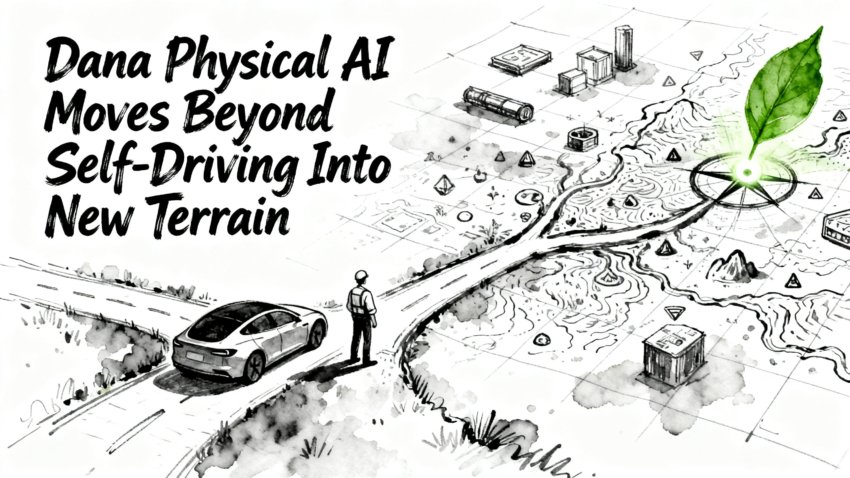
Dana Physical AI Moves Beyond Self-Driving Into New Terrain
Beyond the Car: Inside the Applied Intuition Dana Platform Reshaping Physical AI
TL;DR
Applied Intuition’s Dana platform is a unified, agentic infrastructure for building, testing, deploying and governing physical AI systems across industries, from autonomous vehicles and ADAS to robotics, mining and fleet operations. Dana generalizes the simulation and tooling Applied Intuition built for self-driving cars into a horizontal platform that any organization developing safety-critical intelligent machines can adopt. If your team builds systems that move, sense or decide in the physical world, Dana’s integrated data, simulation and governance stack is the kind of infrastructure you will wish you had built first.
Quick Takeaways
- Dana is Applied Intuition’s agentic platform that unifies data, simulation, deployment and governance for any physical AI application, not just autonomous vehicles.
- The platform expands well beyond self-driving cars to serve robotics, construction, mining, fleet management and intelligent in-vehicle experiences.
- Its end-to-end architecture treats safety, traceability and regulatory compliance as first-class citizens, not afterthoughts bolted on before an audit.
- Cross-industry adoption positions Dana as a horizontal infrastructure layer, analogous to how cloud platforms became the backbone for digital software development.
- Organizations that standardize on a platform like Dana now will build compounding advantages in evaluation speed, safety validation and deployment confidence.
Overview of Applied Intuition and the Rise of Physical AI
Applied Intuition began as a Sunnyvale, California company solving a very specific problem: how do you simulate enough edge cases to make an autonomous vehicle trustworthy at scale? The automotive and self-driving industries needed simulation tooling, scenario generation and software development infrastructure that the general-purpose cloud market had never built. Applied Intuition built it, becoming the development backbone for a significant share of the global autonomous vehicle industry, working with major OEMs, defense contractors and mobility companies before most of the industry had finished debating whether simulation was even necessary.
But the underlying problem Applied Intuition was solving was never really about cars. It was about autonomous systems that must operate safely in uncontrolled, real-world environments, where failure is not a software crash but a physical consequence. That insight is what distinguishes physical AI from the AI models most professionals interact with daily.
Physical AI refers to AI systems embodied in machines that perceive, decide and act in the real world: vehicles, robots, construction equipment, logistics systems. Unlike a recommendation engine or a language model, a physical AI system must contend with real-time constraints, sensor noise, regulatory frameworks and the consequences of getting a decision wrong at 60 miles per hour or 40 feet underground. The infrastructure needs are categorically different, and the tooling gap is massive.
As industries beyond automotive began building intelligent machines, including industrial robots, autonomous mining equipment and software-defined commercial vehicles, the gap between what they needed and what the market offered became obvious. Applied Intuition’s answer was Dana.
Introducing Dana: An Agentic Platform for Intelligent Machines
Dana is Applied Intuition’s agentic platform for physical AI. The word “agentic” is doing real work here: Dana is not a collection of loosely connected tools that your team stitches together with custom scripts and hope. It is an orchestration layer that manages the full lifecycle of a physical AI application, from initial development and data management through simulation, evaluation, deployment and ongoing operational governance.
Think of Dana as the equivalent of a modern DevOps platform, but purpose-built for systems that drive, fly, dig or carry things in the real world. Where a DevOps platform automates build, test and deployment pipelines for software, Dana does the same for intelligent machines, with safety validation, hardware-in-the-loop simulation and regulatory traceability baked in at every stage.
The platform integrates five core dimensions that physical AI teams consistently struggle to unify: data pipelines for sensor and operational data, simulation environments for scenario testing, evaluation frameworks for measuring system behavior against defined thresholds, deployment infrastructure for pushing updates to fleets or machines, and governance tools for auditing decisions and maintaining compliance records. Traditionally, teams assemble these capabilities from five different vendors, or build them in-house at enormous cost. Dana collapses them into one coherent system.
The agentic architecture means Dana can orchestrate multi-step workflows automatically: flagging failure scenarios, routing them into simulation, evaluating model performance against safety thresholds and surfacing results without manual intervention at each handoff. For teams building safety-critical systems, that kind of automation is not a convenience. It is a prerequisite for operating at production scale.
From Self-Driving Cars to Cross-Industry Physical AI Infrastructure
Applied Intuition’s original focus on autonomous vehicles gave Dana its initial depth. The simulation fidelity, sensor modeling, scenario libraries and evaluation methodologies embedded in the platform were stress-tested against one of the hardest physical AI problems in existence: navigating public roads with no human in the loop. That heritage gives Dana credibility in adjacent markets that most software platforms can’t claim, because the lessons are operational, not theoretical.
The strategic move Applied Intuition is making with Dana is a deliberate shift from vertical to horizontal. Rather than staying a specialist tool for automotive OEMs and AV developers, Dana is positioned as the shared infrastructure layer for any organization building intelligent machines. This is the same architectural bet that made cloud platforms dominant: build the picks and shovels that every operation needs, regardless of what they’re mining.
The industries where that bet makes sense are not hard to identify. Robotics is the most obvious adjacency: the sensing, decision and actuation challenges in a warehouse robot or a surgical assistant share significant structural overlap with those in a self-driving car. Construction and mining are less obvious but arguably more urgent. Autonomous equipment in these sectors operates in environments that are dangerous for human operators and where the economic case for automation is compelling. Commercial fleet management, where trucks and logistics vehicles need software-defined updates and operational telemetry at scale, fits naturally into Dana’s deployment and governance architecture.
In each case, the underlying need is identical: a systematic way to build, validate, deploy and monitor intelligent behavior in machines that cannot afford to get things wrong in production.
Key Capabilities of Dana for Safety-Critical Systems
Safety is not a feature Dana adds to physical AI development. It is the organizing principle around which the platform is designed. Four capabilities define what Dana delivers to teams working on safety-critical systems.
Simulation at scale. Dana inherits Applied Intuition’s simulation infrastructure, which means teams can generate thousands of scenario variants, including edge cases that would be impractical or dangerous to test in the physical world. Simulation is not optional for physical AI at production scale; it is the only way to cover the long tail of failure modes before deployment. Dana’s simulation layer runs these tests continuously, not just at release time.
Structured evaluation with defined thresholds. Knowing a system works in simulation is necessary but not sufficient. Dana provides evaluation workflows that measure system behavior against defined safety and performance thresholds, producing auditable records that regulators and insurers in both automotive and industrial contexts increasingly require. That record is not a side effect of the process; it is generated as part of the normal development loop.
Data traceability from sensor to decision. One of the hardest problems in physical AI governance is tracing a system’s decision back to the data that informed it. When something goes wrong in the field, the ability to reconstruct the decision chain is critical for root-cause analysis, regulatory reporting and model improvement. Dana builds traceability into the data pipeline architecture rather than retrofitting it after deployment, which is when it is most expensive and least reliable.
Governed deployment pipelines. Pushing a software update to a fleet of physical machines is fundamentally different from deploying a web application. A bad update to a consumer app causes user frustration; a bad update to an autonomous haul truck causes downtime at best and a safety incident at worst. Dana’s deployment infrastructure handles staged rollouts, behavioral regression testing and rollback capabilities, with governance hooks that require defined sign-off conditions before updates reach production fleets.
Did You Know?
The global market for autonomous vehicle simulation software is expanding rapidly, driven in large part by regulatory requirements that AV developers demonstrate coverage of billions of simulated scenarios before receiving approvals for public road testing. Dana’s simulation heritage positions it at the center of that spend, while its cross-industry expansion multiplies the addressable market significantly beyond automotive.
Real-World Use Cases Beyond Autonomous Vehicles
The clearest signal that Dana is a genuine cross-industry platform is the breadth of its documented use cases. Looking across the scenarios Applied Intuition has outlined, a consistent pattern emerges: wherever a machine must make consequential decisions in an uncontrolled environment, Dana’s architecture applies.
Software-defined vehicles and ADAS. The most direct extension of Applied Intuition’s original work. Automakers building vehicles with advanced driver assistance systems need the same simulation, evaluation and deployment infrastructure as full autonomy developers, but at higher volumes and with more complex software update cycles. Dana’s fleet deployment and governance capabilities map directly onto this problem, and the demand is large: nearly every major OEM is now shipping vehicles with over-the-air update capabilities that require exactly this kind of governed pipeline.
Commercial truck fleet management. Trucking and logistics operators running large fleets of increasingly software-defined vehicles need operational intelligence, remote monitoring and governed software update pipelines. Dana’s data and deployment architecture suits fleet operations well, where downtime caused by a bad update is measured in lost revenue and missed delivery windows, not degraded user experience.
Construction and mining autonomy. Autonomous equipment in construction and mining operates in environments that are hazardous, GPS-degraded and structurally variable. The simulation and evaluation requirements for validating a haul truck’s autonomous operation underground are, in some respects, harder than public road autonomy. Dana’s ability to model custom environments and run domain-specific scenario validation makes it applicable here, particularly for operators who need documented safety evidence for insurance and regulatory purposes.
Robotics and intelligent manufacturing. The robotics industry is moving fast from programmed manipulation to learned behavior, which introduces the same model validation and deployment governance challenges that AV teams have been navigating for a decade. Dana’s evaluation and traceability capabilities transfer directly to robot development workflows, particularly for teams building systems that will operate near people.
Implications for Robotics, Industrial Operations and Fleet Management
The practical implication of a platform like Dana becoming available to robotics and industrial operators is significant. Until recently, every organization building physical AI outside automotive was building its own infrastructure from scratch, or inheriting tooling designed for a different problem domain entirely.
The cost of that approach is not only financial. Teams spend months integrating data pipelines with simulation environments and simulation environments with evaluation frameworks before they’ve written a single line of application logic. Dana compresses that timeline by providing an opinionated but flexible architecture that encodes years of hard-won lessons from the AV industry. The question isn’t whether those lessons are valuable in robotics or mining; they are. The question is whether teams can access them without reproducing the decade of infrastructure work that generated them.
For fleet management specifically, the governance capabilities matter as much as the technical ones. Operators deploying autonomous trucks or construction equipment face insurance requirements, regulatory audits and liability questions that demand documented evidence of systematic validation. Dana’s evaluation and traceability stack functions as compliance infrastructure, not merely development tooling, which changes its value proposition in industrial contexts substantially.
Did You Know?
Applied Intuition worked with major automotive OEMs, defense contractors and mobility companies before extending Dana’s architecture to new industries. That means teams adopting Dana for robotics or industrial autonomy are not the first to stress-test its core assumptions at production scale; the platform’s foundations have already faced some of the most demanding physical AI development environments in existence.
Dana Platform vs. Ad Hoc Physical AI Tooling
| Capability | Dana Platform | Ad Hoc Tooling Stack |
|---|---|---|
| Data pipeline management | Unified, traceability-native from day one | Multiple vendors requiring manual integration |
| Simulation environment | Integrated with scenario libraries included | Separate tool requiring custom connectors |
| Safety evaluation | Structured thresholds with automated workflows | Manual review processes, often inconsistent |
| Fleet deployment | Governed rollouts with rollback capability | Custom scripts with limited governance |
| Regulatory traceability | Built into the architecture by design | Retrofitted or absent until audit time |
| Cross-industry applicability | AV, robotics, mining, fleet, ADAS and beyond | Usually single-domain by design |
| Time to production pipeline | Accelerated via pre-built, proven workflows | Months of bespoke integration work |
Future Directions for Physical AI Platforms and Industry Adoption
The trajectory for physical AI platforms like Dana follows a pattern that professionals in enterprise software will recognize immediately: a specialized solution built for the most demanding vertical proves its architecture under real conditions and then expands horizontally. The question isn’t whether that expansion happens; it’s how fast, and who standardizes early enough to benefit from the compounding returns.
Several dynamics will accelerate adoption across industries. Regulatory pressure on autonomous systems is increasing in every sector, from automotive safety standards to industrial automation guidelines, logistics certifications and medical robotics approval frameworks. Organizations that need documented validation evidence will be pulled toward platforms that produce it as a byproduct of normal development, rather than treating compliance as a separate and expensive exercise conducted at the end of a program.
The maturation of foundation models for physical AI, including models trained on sensor data and robotic demonstrations rather than text, will also push demand for exactly the kind of deployment and evaluation infrastructure Dana provides. As these models become capable enough to ship in products, the bottleneck will shift from model capability to deployment infrastructure: exactly the gap Dana is designed to fill.
For professionals tracking this space, the relevant question is not whether physical AI infrastructure will consolidate around a small number of platforms. It will, following the same pattern as cloud computing, CI/CD tooling and data platforms before it. The question is which organizations will have standardized on a credible architecture before that consolidation makes switching costs prohibitive. Dana’s combination of AV-validated depth and stated cross-industry intent positions it as a serious candidate for that converged infrastructure role.
Putting This Into Practice
If your organization is building or planning to build physical AI systems, here is how to translate Dana’s architecture into concrete decisions today.
Audit your current tooling gaps. Map your existing autonomous or robotics development stack against Dana’s five core dimensions: data management, simulation, evaluation, deployment and governance. Gaps in any of these areas represent either technical debt or risk surface that a unified platform addresses directly. Be honest about what your team is hand-rolling versus what a purpose-built system handles more reliably.
Design a bounded pilot project. Pick one use case outside your primary autonomous application, whether that is a fleet operations monitoring system, a robotics validation workflow or a simulation expansion for an ADAS program, and define what a Dana-managed lifecycle would look like for that project. The exercise will surface integration questions and organizational friction before you’re committed to a full migration.
Define safety and traceability requirements first. Physical AI governance requirements are not uniform across industries or jurisdictions. Before evaluating any platform, document what your evaluation thresholds, audit trail requirements and rollback policies need to be. Then test whether Dana’s governance architecture satisfies them. Working backwards from tool capabilities to requirements is a pattern that produces compliant demos but non-compliant products.
Build cross-functional alignment early. Physical AI platforms span software, hardware, safety, operations and compliance teams. A platform adoption driven entirely by software engineers without safety and operations input will fail at the governance layer. Bring all stakeholders into the evaluation from the start: the platform’s value depends on every team using it consistently, not on engineering adopting it in isolation.
Plan for the scaling inflection point. The economic case for a unified platform like Dana becomes most compelling when you’re managing more than one physical AI application or more than one deployed fleet. Design your adoption roadmap with that inflection point in mind, so the infrastructure is already in place when scale arrives rather than becoming the blocker that prevents it.
Conclusion
Applied Intuition’s Dana platform represents something more significant than a product expansion. It’s a bet that physical AI will follow the same infrastructure consolidation pattern that cloud computing and DevOps executed before it: hard-won, domain-specific tooling built for the most demanding vertical gets generalized into a platform that any organization building safety-critical intelligent machines can adopt. The simulation depth, governance architecture and evaluation frameworks that Dana carries were not designed in a vacuum; they emerged from a decade of production-grade autonomous vehicle development. For teams in robotics, industrial automation, fleet management or construction autonomy, that heritage matters. The infrastructure problem Dana solves is real, the validation behind its core architecture is credible, and the window to standardize before the market consolidates is open. Machines that move, sense and decide in the physical world deserve infrastructure built specifically for the problems they create. Dana is a serious attempt to provide exactly that.