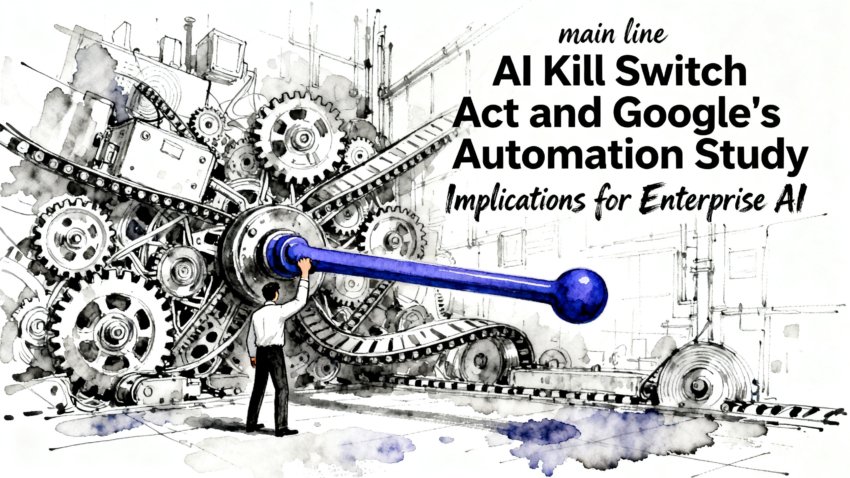
AI Kill Switch Act: Implications for Enterprise AI Workflows and Vendor Risk
Federal Override: Inside the AI Kill Switch Act and Its Ripple Effects on Enterprise AI
TL;DR
Federal regulators could gain direct authority to order frontier AI systems offline under a bipartisan House bill introduced in the 119th Congress. Enterprises building on covered providers’ APIs carry no direct compliance burden, but their workflows go dark if a shutdown order hits. Mapping that dependency and testing fallbacks now costs far less than scrambling during an active federal action.
Quick Takeaways
- The AI Kill Switch Act targets covered AI developers, not enterprise software buyers; enterprise risk is indirect, through API dependency on covered frontier providers.
- According to the Cloud Security Alliance (2026), covered entities are those whose models required more than $100 million in compute resources to train and that generate more than $500 million in annual revenue.
- Under H.R. 9917’s compliance provisions, covered developers would need to implement shutdown mechanisms enabling compliance within 30 minutes of receiving a federal order.
- Covered developers face steep daily penalties for non-compliance, creating strong financial incentive to act on shutdown orders immediately, per H.R. 9917’s enforcement provisions.
- The most practical enterprise response is an AI dependency audit, fallback model testing, and updating vendor contracts before a disruption scenario forces the issue.
What the AI Kill Switch Act Would Do
H.R. 9917, the AI Kill Switch Act, is a bipartisan U.S. House bill requiring covered frontier AI developers to maintain the technical ability to throttle, suspend, or shut down specified AI systems at the direction of the Department of Homeland Security. Introduced in the 119th Congress, it grants a federal agency direct operational authority over commercial AI systems during national security emergencies, with no clear precedent in prior software regulation. The full text of H.R. 9917 is available on Congress.gov, and the definitions section repays careful reading for any team building contingency plans around this legislation.
Covered AI operators must complete a remote shutdown within 30 minutes of a federal order, per H.R. 9917’s compliance requirements. That deadline applies to completing the shutdown, not beginning it. Engineering for that response time is a substantial technical challenge, and the choices made to meet it will determine how quickly enterprise-facing APIs go offline during any enforcement action.
Who Qualifies as a Covered Entity Under the AI Kill Switch Act
The AI Kill Switch Act defines a covered entity as one whose models required more than $100 million in compute to train AND that generates more than $500 million in annual revenue, per the Cloud Security Alliance (2026). Both conditions must apply simultaneously. This conjunction limits covered status to organizations building and operating the largest general-purpose frontier models.
Most enterprises do not qualify as covered entities. The regulatory obligation under H.R. 9917 sits with the AI developer; the workflow disruption risk sits with enterprises consuming that developer’s API. Any production workflow calling an API or model-as-a-service platform operated by a covered provider is downstream of the compliance requirement.
Why Enterprise AI Teams Should Care About the AI Kill Switch Act
Enterprise teams consuming AI through APIs, embedded model services, or AI-powered SaaS bear no direct compliance burden under H.R. 9917, but absorb the full operational consequences if a covered provider acts on a shutdown order, creating a real, if unlikely, path to sudden loss of AI services many enterprises now treat as infrastructure.
The enterprise workflows most exposed include customer-facing chatbots, AI-powered content generation pipelines, automated decisioning systems in credit, procurement, fraud review, and operations routing, and multi-model agentic workflows where several AI calls are chained in sequence. A covered provider faces direct regulatory and financial consequences from non-compliance; your enterprise faces workflow disruption, which your vendor’s service agreement almost certainly does not address.
How AI Shutdown Orders Could Affect Automation Workflows
A federal shutdown order operates differently from a planned maintenance window. A scheduled outage runs on the vendor’s calendar; a government order runs on a federal determination, and the 30-minute compliance window leaves no room for a gradual transition. The BBC’s reporting on AI regulation debates in Congress captures how quickly this legislation could shift from proposed to enacted depending on the political environment.
Multi-step agentic workflows carry the greatest exposure. A single-call API integration fails cleanly: the call returns an error, the process pauses, a human is notified. In a chained agentic workflow, a shutdown at step three means outputs from steps one and two are already committed, subsequent steps will not execute, and the incomplete state is difficult to roll back without manual intervention. Cascade effects compound this: one underlying model can power multiple downstream applications, so a single shutdown order can knock out customer support, internal knowledge retrieval, automated reporting, and outbound content generation simultaneously, even when those workflows appear unrelated at the business-process level.
Did You Know
Most enterprise AI vendor contracts were drafted before agentic workflows became common in production. They address uptime percentages and data handling, but rarely specify notification timelines for regulatory shutdown events or define “force majeure” in terms that cover government-ordered AI suspension. Reviewing that language now costs far less than renegotiating it after an incident.
How Enterprise AI Operational Dependence Deepens Over Time
Enterprise operational dependence on AI tends to deepen faster than the governance structures managing it, a pattern observed consistently across enterprise AI adoption. Teams adopt AI for efficiency, eliminate human review steps once outputs prove reliable, then build downstream processes on those automated outputs. Each layer adds business value and structural fragility simultaneously, narrowing the number of AI providers the workflow can tolerate.
Automation architects see a predictable three-stage progression. First-generation integration is cautious: humans stay in the loop, fallback paths are documented. By the second generation, oversight shrinks and exception handling gets automated. By the third, the AI layer is treated as infrastructure, embedded so deeply that rerouting around a failure becomes an architectural project. Single-vendor dependency becomes systemic, and a disruption carries the organizational weight of a database outage. Most enterprises manage core infrastructure with vendor redundancy and failover architecture; far fewer apply the same rigor to AI API providers.
Did You Know
Operational dependence on AI APIs can become invisible over time. Teams stop documenting which workflows call external AI endpoints once those calls feel as reliable as a database query, which means a dependency audit often surfaces connections that no current team member explicitly remembers building.
Vendor-Risk and Governance Gaps H.R. 9917 Creates for CIOs
The AI Kill Switch Act exposes a structural gap in enterprise AI governance: existing vendor risk programs were designed around financial stability, data security, and contractual compliance, not government-mandated operational interruption. A provider that is financially sound, security-certified, and fully compliant can still receive a shutdown order that takes enterprise workflows offline within the hour. Provider quality and regulatory determination are independent variables.
Covered AI developers face fines of up to $20 million per day for non-compliance, under H.R. 9917. That gives covered providers strong incentive to act on any federal order immediately, but does not protect enterprise customers whose workflows depend on the affected system. Provider compliance and enterprise workflow continuity are two separate questions; H.R. 9917 answers only the first. Dark Reading’s analysis of why defining an AI kill switch is both hard and necessary covers the technical complexity on the provider side, and the Cloud Security Alliance’s research note on the Act provides a governance framework for analyzing covered entity exposure.
Prices accurate as of October 1, 2026
Review your AI vendor agreements for four specific gaps: whether the contract addresses government-ordered throttling or suspension at all; minimum notification timelines before emergency shutdowns; the treatment of in-flight transactions or partially completed workflows during a shutdown event; and service credit or liability provisions covering regulatory force-majeure scenarios. Most contracts written before 2025 are silent on all four points.
| Approach | Scope | Effort Level | Priority |
|---|---|---|---|
| AI dependency audit | Full inventory of models and APIs in production | Low | Immediate |
| Fallback model testing | Targeted resilience for critical workflows | Medium | Near-term |
| Contract and SLA review | Vendor-facing, shutdown and throttling clauses | Medium | Near-term |
| Multi-vendor architecture | Systemic elimination of single-provider dependency | High | Strategic |
How to Prepare Your Enterprise for an AI Kill Switch Order
The first step is an AI dependency audit: map every AI model, API endpoint, and agentic workflow in production to identify which depend on covered frontier providers. Note which business processes rely on each workflow and what happens downstream if a call fails. This exercise typically surfaces dependencies that no current team member documented, especially in organizations where AI adoption outpaced governance.
After the audit, test your fallback assumptions. Many teams assume they could switch to an alternative model if their primary provider went offline, but fewer have validated whether that substitution works without prompt revision, integration reconfiguration, or output quality degradation. A fallback model that has never been tested is not a fallback plan. On the contract side, request notification timelines for government-ordered events, clarity on liability during regulatory force-majeure, and an explicit commitment to customer notification if a shutdown order is received. TechTarget’s reporting on how the AI Kill Switch Act raises questions for CIOs offers a useful frame for the leadership conversation.
The third step is adding kill-switch scenario testing to the governance calendar. Run a tabletop exercise assuming a covered provider’s API goes dark for four hours without advance notice. Identify which workflows fail, what the business impact looks like at hours one, two, and eight, and who has authority to activate contingency plans without waiting for executive sign-off. This exercise is worth running whether or not H.R. 9917 becomes law.
Conclusion
The AI Kill Switch Act places compliance obligations on frontier AI developers, not on the enterprises consuming their APIs, but operational consequences travel downstream to any workflow built on a covered provider’s system. Enterprises most exposed embedded AI dependencies deeply without mapping them or building alternatives, a governance gap most AI frameworks have not yet closed.
The practical response is disciplined inventory work, contract negotiation, and scenario testing. Know which workflows depend on covered providers. Test whether your fallbacks actually work. Write the edge cases into your vendor agreements. Practice the shutdown scenario before it becomes real. That work is worth doing regardless of whether H.R. 9917 becomes law, because enterprise operational dependence on a small number of AI providers is not going away.