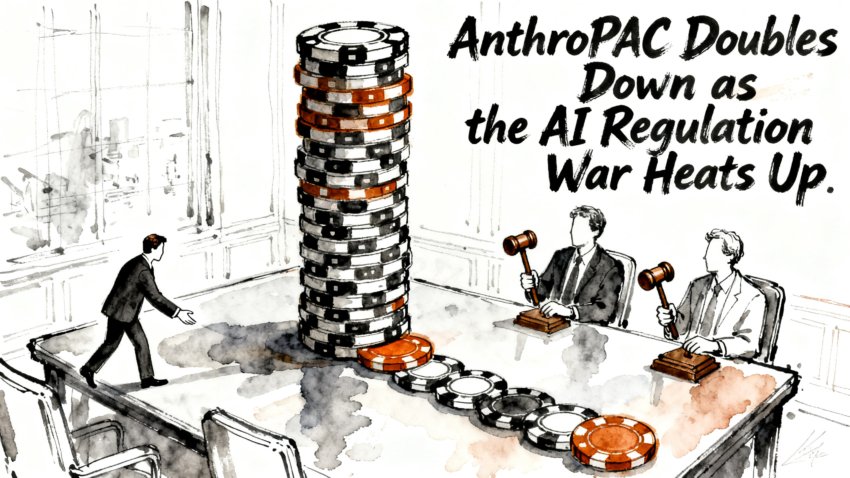
AnthroPAC Doubles Down as the AI Regulation War Heats Up
Anthropic PAC Funding: $40 Million Commitment Puts Anthropic Among the Top AI Political Spenders in the 2026 Cycle
TL;DR
- Anthropic initially committed $20 million to the Public First Action super PAC, according to The New York Times (2026).
- That figure doubled to $40 million total, according to Axios (2026), making Anthropic one of the largest AI political spenders in the 2026 cycle.
- CEO Dario Amodei separately contributed $1 million from personal funds, according to Politico (2026).
- Anthropic’s lobbying budget grew more than fourfold to $1.56 million in Q1 2026, according to NPR (2026).
- AnthroPAC is the internal vehicle coordinating Anthropic’s political activity alongside Public First Action.
Quick Takeaways
- Anthropic has more than doubled its initial super PAC commitment in under a year, signaling a long-term political strategy rather than a one-time hedge.
- The $40 million total commitment, according to Axios (2026), puts Anthropic in direct competition with OpenAI’s parallel political infrastructure.
- AnthroPAC gives Anthropic a branded, traceable political presence that separates corporate strategy from executive personal giving.
- Federal AI legislation is actively moving through Congress, and PAC-backed candidate support is one lever companies use to shape which members hold key committee seats.
- Understanding the difference between a super PAC, a corporate PAC, and a 501(c)(4) is now table stakes for anyone tracking AI policy outcomes.
Why Anthropic Is Escalating Its Political Spending in 2026
Anthropic is escalating its political spending because federal AI bills are advancing through the 119th Congress, and companies that shape the regulatory conversation early have outsized influence over the rules that follow. Getting in early costs less than complying with regulations written without your input.
Bills advancing through the 119th Congress range from liability frameworks to mandatory safety evaluations. Committees with jurisdiction over technology, commerce, and national security hold members whose positions on AI range from permissive to restrictive. Which of those members win their 2026 races matters to Anthropic’s business environment, and super PAC spending in competitive districts is among the most direct ways a corporation can tilt that composition without violating direct contribution limits.
Anthropic also has a competitive motive. OpenAI, Google, and Microsoft all maintain significant political presences in Washington. Anthropic’s PAC strategy is partly about ensuring its safety-first framing reaches the legislators who write the rules; a company that abstains while rivals spend heavily is choosing to be absent from that room.
What Are AnthroPAC and Public First Action?
AnthroPAC is the federally registered political action committee through which Anthropic coordinates employee political contributions and signals the company’s electoral priorities. It operates under the standard corporate PAC framework established by the Federal Election Commission: AnthroPAC can solicit contributions from employees within defined limits, bundle those funds, and contribute directly to federal candidates up to the legal maximums.
Public First Action is a super PAC that can accept unlimited corporate treasury funds and spend them independently on elections without coordinating with any candidate. Anthropic’s $40 million total commitment, according to Axios (2026), flows primarily through Public First Action, which operates as an independent expenditure committee running its own ads, voter contact programs, and get-out-the-vote efforts in targeted races.
AnthroPAC handles direct candidate support and employee engagement; Public First Action handles large-scale independent spending prohibited under direct contribution rules. Together they give Anthropic full-spectrum political infrastructure covering both the FEC-regulated direct-contribution lane and the unlimited independent-expenditure lane created by Citizens United v. FEC.
How Anthropic’s PAC Spending Connects to Federal AI Regulation
Federal AI legislation in the 119th Congress spans three competing frameworks. One favors principles-based requirements leaving implementation to industry. A second prescribes mandatory pre-deployment evaluations, third-party auditing, and civil liability for harms. A third wants minimal federal intervention, preferring state-level experimentation. Anthropic benefits most from a framework that treats rigorous safety processes as a market differentiator, because Anthropic’s entire brand rests on safety.
Direct lobbying reinforces the PAC strategy. Anthropic more than quadrupled its lobbying spending to $1.56 million in Q1 2026, according to NPR (2026). Those funds pay registered lobbyists who brief staffers, attend hearings, and circulate white papers on technical questions most members of Congress lack the background to evaluate independently. PAC money shapes the electoral environment; lobbying money shapes legislative text once the election is decided.
Anthropic is not merely playing defense; it is working to define what “responsible AI” means in statutory language before a less favorable definition gets locked in.
Did You Know?
Dario Amodei contributed $1 million to Public First Action from personal funds, according to Politico (2026). Personal contributions to a super PAC are subject to public FEC disclosure but face no dollar ceiling, which is why they are increasingly common among tech executives who want to signal personal conviction alongside corporate commitment.
Corporate PACs vs. Super PACs vs. 501(c)(4) Groups: Key Differences
A corporate PAC, a super PAC, and a 501(c)(4) social welfare organization are three legally distinct vehicles for moving political money, each with different funding sources, disclosure requirements, and limits on candidate contact. The structure of political action committees is well-documented, but the practical distinctions are often glossed over in technology coverage.
A corporate PAC, like AnthroPAC, is funded by voluntary contributions from employees and executives, can give directly to federal candidates up to FEC limits, and discloses all contributions and expenditures publicly. A super PAC, like Public First Action, can accept unlimited contributions from corporations, unions, and individuals, but cannot give directly to candidates or coordinate with them, and must spend fully independently. A 501(c)(4) social welfare organization can engage in political activity as long as it is not the primary purpose, and donor identities are not disclosed on public FEC filings, which is why these groups carry the “dark money” label in press coverage.
Anthropic’s current strategy uses the first two vehicles. Its initial $20 million commitment to Public First Action, according to The New York Times (2026), was a significant opening bet for a company with a previously low political profile. Doubling that total to $40 million, according to Axios (2026), signals that Anthropic views political spending as a core strategic function rather than an incidental cost.
What Anthropic’s Political Spending Means for Congress and Federal AI Policy
Anthropic’s $40 million commitment will give it a measurable presence in competitive 2026 congressional races, particularly for seats on the Senate Commerce Committee and the House Energy and Commerce Committee. Public First Action can run advertisements, fund canvassing, and support digital outreach in districts where a single race could shift committee leadership or the chamber balance. Committee assignments on these two committees directly determine which AI bills receive markup hearings and which die in subcommittee. Active legislation can be tracked through Congress.gov.
For professionals who build products on AI APIs or depend on AI tooling, the regulatory outcome is not abstract. A liability framework that assigns responsibility to model developers differently from application developers changes your risk calculus. A mandatory safety evaluation regime applying to frontier models but not fine-tuned derivatives affects which tools remain available at what cost. A federal preemption provision that supersedes state AI laws simplifies your compliance surface. These are the provisions being written now, and the companies spending in elections are betting they can influence who votes on them.
How Anthropic’s Political Strategy Compares With Other AI Companies in 2026
Anthropic, OpenAI, Google, Microsoft, and Meta all maintain political spending infrastructure in Washington. OpenAI has reportedly launched its own super PAC and pursued a parallel strategy of direct lobbying combined with electoral spending. Google and Microsoft have maintained well-funded Washington operations for years, with established PACs and registered lobbying shops that predate the current AI policy cycle by more than a decade. Meta’s political spending infrastructure is similarly mature.
Speed of escalation and explicit safety branding distinguish Anthropic here. Most tech companies maintain political operations as a defensive hedge; Anthropic appears to be using political spending as an extension of its positioning as the safety-focused frontier lab. Whether that framing survives contact with the unambiguously electoral nature of super PAC spending is worth watching.
AI Company Political Spending: 2026 Cycle Comparison
| Company | Primary Vehicle | Scale of Commitment | Strategy Focus | Public Framing |
|---|---|---|---|---|
| Anthropic | Super PAC (Public First Action) + AnthroPAC | Major, rapidly escalating | Electoral + direct lobbying | Safety-first AI governance |
| OpenAI | Separate super PAC + direct lobbying | Significant, comparable scale | Electoral + regulatory outreach | Broad AI leadership |
| Google / Alphabet | Established corporate PAC + lobbying | Large, long-standing | Primarily direct lobbying | Innovation and competition |
| Microsoft | Corporate PAC + lobbying shop | Moderate, consistent | Primarily direct lobbying | Responsible AI + security |
| Meta | Mature corporate PAC + lobbying | Large, consistent | Electoral + direct lobbying | Open source and connectivity |
Risks and Criticisms of Anthropic’s PAC Strategy
The primary criticism of Anthropic’s PAC strategy is the tension between its safety mission and the nature of electoral spending. Super PAC dollars go to television ads, digital targeting, and voter persuasion, not to safety research. Critics argue this conflates corporate interest in favorable regulation with genuine public interest in safe AI development. Those interests can overlap, but they are not identical.
A second criticism concerns the concentration of political influence among a handful of well-capitalized AI companies. If Anthropic, OpenAI, and a few platform giants are the dominant voices funding AI policy campaigns, the resulting legislation will reflect their interests more than those of the much larger population of developers, small businesses, and civil society organizations that will live under those rules. FEC disclosure makes spending traceable, but disclosure does not neutralize the influence asymmetry.
Did You Know?
Under the Federal Election Commission’s rules, a company can pay the administrative and operational costs of an employee PAC, including salaries, legal fees, and office space, as long as no corporate funds enter the PAC’s political contribution pool. This is why AnthroPAC can exist as an Anthropic-associated entity while legally remaining an employee-funded vehicle.
How to Track AI Political Spending as a Practitioner
Practitioners who depend on AI tools can track federal AI regulation by monitoring FEC filings, congressional committee assignments, lobbying disclosures, and competitor spending patterns. The following four steps cover the most useful public data sources.
- Track FEC filings quarterly. The FEC’s online disclosure database lets you search by committee name to track AnthroPAC contributions, Public First Action independent expenditures, and comparable filings from OpenAI and other AI companies. The pattern of which candidates receive support tells you more about a company’s actual policy priorities than its press releases do.
- Follow committee assignments after the 2026 elections. Bookmark the relevant Congress.gov pages for the Senate Commerce Committee and House Energy and Commerce Committee. These are the venues where AI bill language gets revised in ways that matter to practitioners; the composition of those committees after November shapes which provisions survive.
- Compare public messaging with lobbying disclosures. Lobbying registrations filed with the Senate and House identify which bills and agencies a company is working. Cross-reference Anthropic’s public white papers and policy letters against bill text on Congress.gov to spot where Anthropic’s stated positions align with or diverge from specific statutory language.
- Watch rival AI firms for escalation. When one major player significantly increases political spending, competitors typically respond. Track PAC registrations and super PAC donations from OpenAI, Google, Meta, and Microsoft to detect emerging spending patterns that could shift the balance of influence on specific legislative provisions.
Conclusion: What Anthropic’s $40 Million PAC Commitment Signals
Anthropic’s move from a $20 million initial commitment, according to The New York Times (2026), to a $40 million total, according to Axios (2026), in under a year signals that AI companies now view federal regulation as the central variable in their competitive landscape. AnthroPAC and Public First Action together give Anthropic full-spectrum political infrastructure across direct candidate support, independent electoral spending, and congressional lobbying.
For anyone building with AI, selling through AI-powered channels, or running operations that depend on AI tooling, the rules shaped by this spending cycle will define compliance costs, liability exposure, and tool availability for years. The question is not whether to care about Anthropic PAC funding; it is how closely you track it and how quickly you adjust when the rules shift.