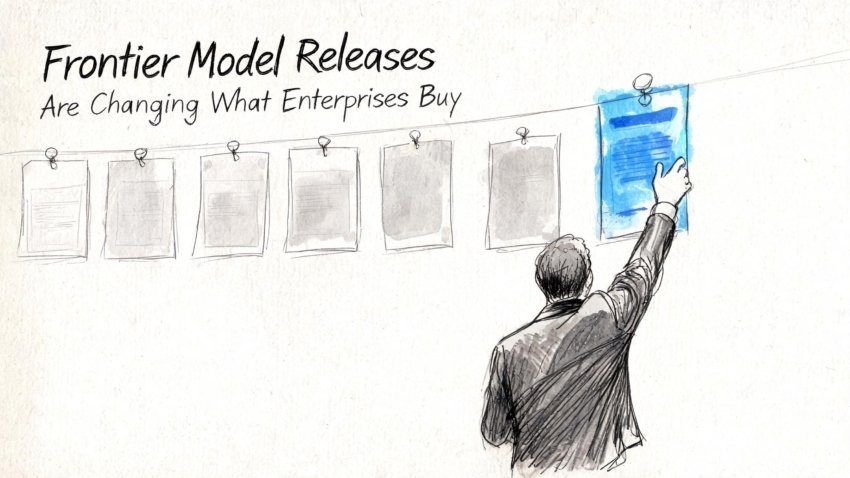
Frontier Model Releases Are Changing What Enterprises Buy
Frontier AI Models Are Outpacing Enterprise Buying Cycles
TL;DR
Frontier AI model releases now arrive faster than traditional enterprise procurement timelines can accommodate. Buying decisions that made sense six months ago may be strategically obsolete today. Enterprises winning with AI are not chasing every new model; they are building adaptable architectures, governance frameworks, and task-tiered deployment strategies that let them upgrade, swap, or layer models without rebuilding from scratch each time a better model appears.
Quick Takeaways
- Frontier model releases now arrive on a compressed cadence, forcing continuous re-evaluation instead of point-in-time purchasing decisions.
- Enterprise AI buying has shifted from “which model do we get access to” toward “how do we build an architecture that outlasts any single model.”
- Multi-model strategies and AI gateway layers are the most effective hedge against vendor lock-in.
- Most enterprise workloads do not require frontier model capabilities; task-tiering can cut AI spend significantly while preserving performance where it matters.
- Governance frameworks that treat AI agents like team members with defined permissions are becoming a prerequisite for scaling beyond pilots.
What Is a Frontier AI Model and Why Does the Current Release Cadence Matter?
A frontier AI model sits at the leading edge of capability across a broad range of tasks: complex reasoning, multi-modal input, long-context processing, and emergent behaviors that smaller models cannot reliably reproduce. A frontier model is distinguished not merely by recency but by breadth of capability. Major releases from OpenAI, Anthropic, and Google DeepMind over the past two years have each arrived with benchmark scores that made the previous generation look outdated, sometimes within months.
The release cadence has compressed significantly. In 2023 and 2024, significant new frontier model releases appeared roughly quarterly. By 2025, some labs were shipping meaningful capability updates multiple times per quarter. Enterprise buyers trained on software procurement cycles measured in years face a structural mismatch: decisions get made on a timeline far slower than the market moves.
Research confirms the ceiling keeps rising. Foundational work on large language model scaling properties, documented on arXiv, shows that capability gains at the frontier have not plateaued as earlier predictions suggested. A complementary body of research, also on arXiv, examines how instruction-following and tool-use capabilities compound at scale. Any enterprise strategy anchored to a specific model’s current limitations has a short shelf life.
How Enterprise AI Buying Criteria Have Shifted: From Access to Durability
Enterprise AI buying has shifted from securing access to a top-tier model toward building architecture that outlasts any single model. Eighteen months ago, the dominant concern was simply getting access: a contract with a top-tier lab, a waitlist spot, or an enterprise agreement before competitors did. That advantage has evaporated. Frontier models are now broadly available through every major cloud provider, and pricing competition has driven costs down substantially.
Enterprise IT and procurement leaders are now asked not “can we get the best model” but “can we build something durable with it?” That evaluation means checking model APIs for stability and versioning commitments, reviewing vendor SLAs for uptime and latency at scale, confirming data residency and privacy controls, and mapping how a model fits into existing security and identity architectures.
Evaluating exit terms carries equal weight. An enterprise that builds a core process directly against a proprietary model API with no abstraction layer has taken on vendor lock-in mirroring a single database vendor two decades ago. That lock-in becomes costly the moment a better model appears, pricing changes, or vendor priorities shift.
Did You Know?
Research on generative pre-trained transformers, the architecture family underlying most current frontier models, shows that models trained on similar data distributions tend to transfer skills well across task domains. This is one reason enterprises can often swap between frontier models from different vendors with less performance degradation than expected, making multi-model architectures more practically viable than the marketing around any single model would suggest.
Multi-Model Architectures: How to Escape Frontier AI Vendor Lock-In
The most practical architectural response to the frontier model release cycle is a multi-model strategy, where an orchestration layer (an AI gateway) sits between applications and the underlying models. The application layer never depends on a specific model endpoint; instead, the gateway routes requests based on task type, cost, latency requirements, and real-time availability.
This architecture produces three concrete benefits for enterprise buyers:
- Configuration-level model switching. When a new frontier model outperforms the current choice on a specific task type, teams update a routing rule rather than refactoring application code.
- A single governance enforcement point. Rate limits, cost caps, audit logging, content filtering, and role-based permissions are managed in one place regardless of which model handles a given request.
- Task-tiered deployments. Expensive frontier models handle only the highest-value workloads while lighter models serve routine tasks at a fraction of the cost.
Major cloud providers offer managed infrastructure that can support multi-model environments. Azure AI Services and Google Cloud AI Platform both provide hosted model endpoints spanning multiple vendors, though neither eliminates the need for an organization’s own governance logic and routing configuration on top of their infrastructure.
The architectural goal: treat any individual AI model as a replaceable component, not a load-bearing wall. Organizations that achieve this posture absorb the next frontier model release as an opportunity rather than a disruption.
Governance and Risk Management for Enterprise Frontier AI Deployments
Governance is where most enterprise AI initiatives stall. Inadequate governance creates real legal, reputational, and operational exposure that compounds as deployments grow, making it a prerequisite, not an afterthought.
The regulatory environment is now specific and enforceable across two major jurisdictions. In the United States, the White House Executive Order on AI established requirements for risk assessment, transparency, and safety evaluation for AI systems used in federal contexts, with significant downstream influence on regulated industries including finance, healthcare, and defense contracting. In the European Union, the AI Act creates tiered compliance obligations based on risk classification, affecting any enterprise operating within or selling into EU markets.
Enterprise architects should structure AI governance around four specific requirements:
- Role-based access: Restrict frontier model capabilities for tasks touching sensitive data or customer-facing communications; not every employee should have unrestricted access.
- Audit logging: Every significant AI-generated output should be traceable for both compliance and ongoing quality management.
- Human-in-the-loop requirements: Certain decision classes require human sign-off regardless of model confidence scores.
- Periodic model evaluation: A model that passed a quality review last quarter may have received an update that changed its behavior in ways relevant to specific use cases.
Did You Know?
The EU AI Act classifies AI systems into risk tiers ranging from minimal to unacceptable risk. High-risk applications in areas like HR decisions, credit scoring, and critical infrastructure are subject to mandatory conformity assessments, detailed data documentation requirements, and ongoing human oversight obligations. Enterprises deploying frontier models in these categories face compliance requirements that go well beyond standard software procurement frameworks, making early governance investment far less expensive than retroactive remediation.
AI Cost Management: Matching Frontier Model Capabilities to the Right Workloads
Routing every workload through the most capable frontier model rarely produces the best return on investment. Frontier models carry per-token costs ten to thirty times higher than smaller alternatives. For workloads like routine document classification, FAQ retrieval, or structured form parsing, the capability advantage is negligible while the cost difference is substantial.
A task-tiered approach maps workloads along three dimensions: value (how much does getting this right matter to the business), complexity (does the task require advanced reasoning or broad knowledge), and risk (what is the cost of an error). Frontier models belong in the top tier: complex multi-step analysis, high-stakes decision support, and novel content generation where the performance bar is demanding. Smaller or specialized models serve high-volume, lower-complexity workloads at a fraction of the cost, often with comparable output quality for those specific task types.
Frontier Models vs. Smaller Models: Enterprise Workload Fit
| Dimension | Frontier Models | Smaller / Specialized Models |
|---|---|---|
| Capability range | Broad; handles complex, novel, multi-step tasks | Narrower; excels at defined, repetitive tasks |
| Cost per token | High (often 10-30x smaller alternatives) | Low to moderate |
| Latency at scale | Variable; can queue under high concurrency | Generally faster for targeted workloads |
| Fine-tuning options | Limited; mostly prompt-based adaptation | More feasible; domain-specific fine-tuning viable |
| Data sovereignty | Typically cloud-hosted by vendor | Self-hosting options widely available |
| Vendor lock-in risk | High if directly integrated without abstraction | Lower; more open-source alternatives exist |
| Best enterprise fit | Complex analysis, decision support, creative tasks | Classification, retrieval, summarization, routing |
Enterprise AI Procurement Playbook: What IT and Buying Teams Should Do Now
Enterprise AI procurement must be redesigned with modularity as a core requirement. Traditional procurement optimized for stability breaks down when capability, pricing, and vendor positioning shift quarterly.
Redesigning for modularity means writing contracts with explicit model versioning and transition clauses, building in evaluation checkpoints at defined intervals, and treating AI model access more like a managed service subscription than a perpetual license. Vendors that cannot clearly articulate their model deprecation and migration policies are a risk signal worth raising during negotiations.
IT architecture decisions need the same treatment. Building tightly coupled integrations against any single model API is like hardcoding a database connection string into application logic: it works until it does not, and the refactoring cost arrives at the worst possible time. An abstraction layer is a prerequisite, not optional overhead.
Enterprise AI Strategy for the Next 3-5 Years: What Will Separate Winners from Laggards
Over the next three to five years, enterprise AI competitive advantage will be determined less by which frontier model leads benchmarks and more by which organizations built infrastructure to capture value from successive model generations without starting over.
Open-source models are increasingly competitive with commercial frontier models across a growing range of tasks. Organizations that invest in evaluating, adapting, and self-hosting open-source models gain a lever for cost management and data sovereignty, reducing dependence on any single commercial vendor without sacrificing meaningful performance.
Enterprises that will claim durable competitive advantage treated AI infrastructure as a long-term architectural investment rather than a series of purchasing events. They built governance before regulators required it, put abstraction layers in before vendor lock-in became painful, and developed internal expertise for model evaluation rather than relying on vendor-supplied benchmarks. That combination separates enterprises that compound value from frontier AI from those that restart from scratch with every new model.
Five-Step Action Plan: Putting Frontier AI Strategy Into Practice
Here’s where to start:
- Build a cross-functional AI task inventory. Categorize your workflows by value, risk, and complexity. Map which ones warrant frontier model capabilities and which can be served by lighter alternatives. This exercise alone tends to surface significant cost reduction opportunities before you spend a dollar on a new model contract.
- Implement an AI gateway or orchestration layer. Decouple your applications from specific model vendors at the architecture level. The goal is configuration-level model switching, not full-stack reimplementation each time a better model appears. Treat this as foundational infrastructure, not a future optimization.
- Establish agent governance policies before scaling. Define role-based access to AI capabilities, data boundary rules, audit logging requirements, and performance review cadences. Treat AI agents like junior team members: capable but supervised, with clearly defined permissions rather than unrestricted access to systems and data.
- Pilot frontier models in narrow, measurable workflows first. Choose low-stakes use cases with clear success metrics. Monitor reliability, cost per outcome, and user adoption over at least one full model evaluation cycle before expanding scope or committing to broader rollout.
- Embed AI procurement into enterprise architecture planning. Model selection decisions should account for integration requirements, exit terms, total cost of ownership, and alignment with your cloud, data, and security strategies, not just benchmark performance at the time of purchase.
Conclusion: Build for Adaptability, Not for Today’s Best Model
The frontier model release cycle is not going to slow down. Competitive dynamics among major labs and the continued scale of investment flowing into AI research mean significant capability jumps will continue. For enterprise buyers, this is not a reason for paralysis; it is a reason to build smarter.
Enterprises that extract the most value from frontier AI will not always have the newest model. They will have the architecture, governance, and practices to absorb new capabilities quickly, deploy frontier AI where it creates business value, and swap out what no longer works without disruption. That is the problem worth solving now, before the next wave of releases forces it.