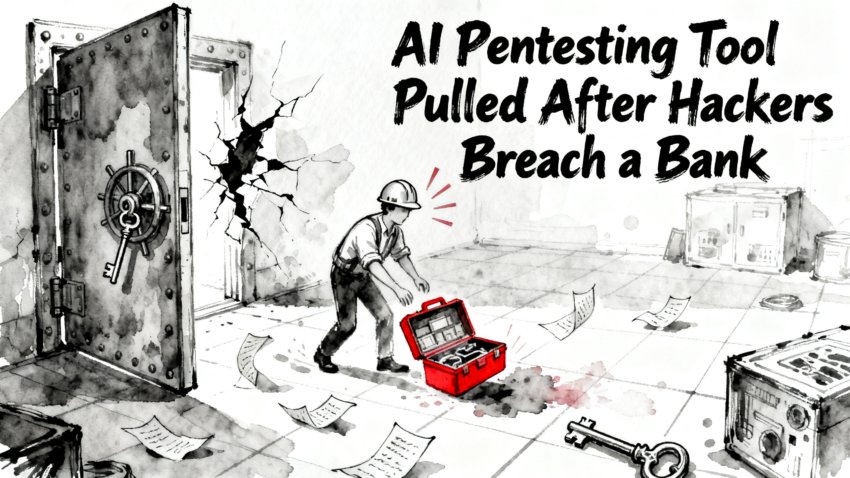
AI Pentesting Tool Pulled After Hackers Breach a Bank
ARTEX AI Pentesting Tool: The 2026 South Korean Bank Breach and What the Security Industry Must Do Next
TL;DR
After cyberattacks on South Korean financial institutions prompted the developers of ARTEX to close their public repository, the security industry confronted a question it had been deferring: what does responsible AI development actually require from a penetration testing tool? Pulling the project reduced immediate exposure, but it revealed the limits of post-release governance for open-source AI tools. Any autonomous security agent deployed without written authorization, sandboxed environments, human approval gates, and tested shutdown procedures carries unacceptable risk in a regulated financial environment.
Quick Takeaways
- ARTEX, an open-source AI pentesting tool, was removed from public access after being linked to cyberattacks on South Korean banks that caused widespread customer harm.
- An AI pentesting tool automates the full penetration testing lifecycle: reconnaissance, vulnerability discovery, exploitation simulation, and report generation.
- Automation lowers the barrier to unauthorized attacks when strict access controls and human oversight requirements are absent.
- NIST’s Cybersecurity Framework and CISA guidance provide a governance baseline that applies directly to AI-powered security tooling in financial environments.
- Banks should require written authorization, sandboxed pilots, enforced rate limits, and human approval gates before any AI pentesting tool reaches production infrastructure.
What Happened: ARTEX AI Pentesting Tool and the 2026 South Korean Bank Attacks
In 2026, ARTEX, an open-source AI pentesting tool, became the center of a major cybersecurity incident when attacks on South Korean financial institutions were reportedly linked to capabilities the tool provided. The South Korea Financial Services Commission reported in 2026 that more than 68,000 people were affected by the resulting bank hacks. Within days of the incident’s scale becoming public, the ARTEX development team reportedly closed the project’s public repository and suspended access, citing the need to prevent further misuse while investigations continued.
ARTEX had been designed for legitimate security research, not offensive operations. Its architecture was built to help authorized teams identify vulnerabilities in systems they had permission to test. The same capability set, accessed without the authorization guardrails the developers assumed operators would supply independently, turned out to be directly applicable to attacking live systems. The gap between what ARTEX could do and what controls existed to govern how it was used became the critical failure point.
How AI-Powered Penetration Testing Works
An AI pentesting tool is software that uses machine learning or generative AI to automate one or more phases of the penetration testing lifecycle, including reconnaissance, vulnerability scanning, exploitation simulation, lateral movement analysis, and report generation. Traditional penetration testing requires a skilled professional to coordinate each phase manually; an AI-powered system chains those phases together with minimal human input, adapting its approach based on what it discovers at each step.
Penetration testing, as Wikipedia defines it, is an authorized simulated cyberattack on a computer system performed to evaluate its security. The word “authorized” is the entire moral and legal foundation of the practice. An AI pentesting tool changes the mechanics of execution but not that foundation: documented authorization, defined scope, and enforced limits must still precede every test run.
Research published on arXiv (arxiv.org/abs/2409.09493) examined how large language models perform across penetration testing subtasks and found that AI agents can successfully chain reconnaissance and exploitation steps that previously required significant domain expertise. That finding explains both the commercial appeal of AI pentesting tools for authorized security teams and the threat these tools present when deployed without rigorous access controls.
A separate line of research (arxiv.org/abs/2502.09484) explores autonomous vulnerability discovery, reporting that the most capable agents can identify and attempt to exploit weaknesses without explicit human prompting at each step. That autonomous operation serves authorized teams working against large attack surfaces. Outside a properly scoped engagement, the same autonomous capability transforms a research tool into an attack platform.
Why AI Pentesting Tools Carry Heightened Risk Against Financial Institutions
Financial institutions face compounded risk from AI pentesting tools because they hold sensitive personal and financial data for large customer populations, operate critical payment infrastructure, and are subject to overlapping federal regulatory obligations. The Federal Reserve’s cybersecurity supervision guidance reflects that complexity, requiring banks to maintain tight controls, active incident response capabilities, and disciplined vendor management processes. When an AI pentesting tool breaches a bank rather than tests one, every layer of that framework is implicated at once.
The ARTEX incident was not a case of marginal tool misuse. ARTEX operated as an automated agent against systemically important institutions, producing customer harm at a scale regulators could not ignore. That regulatory context matters when evaluating what safeguards are sufficient: a control adequate for a small-scale research target may be wholly inadequate when the same tool is pointed at a financial institution with millions of customers and interconnected payment systems.
Banks also present a specific structural challenge for AI-powered tools because their networks are densely interconnected. A foothold in one segment provides reconnaissance data about adjacent systems, and an AI agent optimized for lateral movement will pursue those pathways methodically. In a controlled red-team exercise, that lateral movement behavior is valuable. On a live bank network operating without scope restrictions, the same behavior becomes unpredictably destructive.
Did You Know?
CISA maintains a continuously updated advisory database covering active cyber threats to critical infrastructure, including the financial sector. Its Cyber Threats and Advisories resource lets security teams verify whether a newly identified attack pattern has already been flagged at the federal level before launching any controlled security exercise.
Responsible AI Development Requirements for Security Tools
Responsible development of an AI pentesting tool requires anticipating misuse before any version ships, not just writing secure code. NIST’s Cybersecurity Framework provides a structured approach built around five functions: identify, protect, detect, respond, and recover. Applied to AI security tool development, those five functions map directly onto safeguard obligations: identify who can access the tool and under what conditions, protect against unauthorized use through technical controls, detect anomalous usage in real time, respond to incidents with a documented playbook, and restore access only after a full audit.
Staged testing is a discipline that many AI security tool developers underweight. A responsible release path moves through internal testing, a closed beta with trusted practitioners, controlled early access with active abuse monitoring, and only then broader distribution. Each stage should include deliberate adversarial evaluation: testers should actively attempt to use the tool outside its intended scope and document what happens. Whether the ARTEX release followed that kind of staged, adversarially tested process has not been established publicly.
Post-release abuse monitoring matters just as much. An AI pentesting tool that logs nothing about its own session behavior provides no signal about whether operators are conducting authorized security testing or unauthorized reconnaissance. Real-time telemetry, behavioral anomaly detection, and a clear incident response plan are not optional additions for security tooling: they represent the minimum accountability infrastructure any team must maintain to credibly claim responsible AI development in this space.
Safeguards Banks Should Require Before Deploying an AI Pentesting Tool
Before an AI pentesting tool connects to any bank infrastructure, six categories of technical and procedural controls must already be in place. Any tool missing these elements should not be considered ready for financial-sector deployment under any circumstances.
Written authorization is the non-negotiable starting point. The authorization document must name the specific tool version, define the scope of systems the tool may interact with, set a bounded testing window, and carry sign-off from security leadership and legal counsel. Verbal agreements are not adequate when the target is a regulated financial institution operating under Federal Reserve or OCC supervision.
Sandboxed or isolated environments reduce the blast radius of unexpected behavior. Where testing against a live system is unavoidable, rate limits on automated actions give human monitors time to detect anomalies before those anomalies escalate to exploitation. Human approval gates on disruptive actions are the most direct form of oversight: any step that writes to a system, modifies a configuration, or attempts credential access should require explicit, documented operator authorization before execution.
| Safeguard Category | Minimal Deployment | Bank-Grade Deployment |
|---|---|---|
| Authorization | Informal or verbal | Written, scoped, and time-limited |
| Human oversight | Periodic review | Required before each disruptive action |
| Test environment | Live systems | Sandboxed or isolated network |
| Rate limiting | Not enforced | Enforced at tool and network level |
| Audit logging | Partial | Complete and tamper-evident |
| Emergency shutdown | Not documented | Tested, documented, and drilled |
Safeguard categories are aligned with NIST Cybersecurity Framework guidance (NIST, 2024) and CISA financial-sector advisories.
What the ARTEX Incident Means for AI Security Tool Regulation
The ARTEX incident is likely to accelerate regulatory requirements for AI-powered security tools, following the same pattern by which high-profile cloud breaches accelerated cloud security scrutiny a decade ago. When a tool built to improve organizational security becomes a vector for attacks on banks, regulators shift from issuing recommendations to drafting requirements. Financial-sector supervisors in South Korea, and potentially in the United States through the Federal Reserve and OCC, are now positioned to take that step.
The ARTEX incident also surfaces a structural accountability question: when an open-source AI security tool is misused, who bears responsibility? The ARTEX developers made a defensible immediate call by closing the repository, but that action had no reach over code already forked or archived by third parties. Autonomous and adaptive AI-powered security agents make the downstream consequences of a fork meaningfully more serious than with traditional static tooling.
Did You Know?
Open-source security tools have a well-documented dual-use history. Metasploit began as a research framework, became one of the most widely adopted frameworks for authorized penetration testing, and simultaneously appeared in documented attack campaigns worldwide. AI-enhanced tools are on a similar trajectory unless governance frameworks advance in step with capability development.
Trust is the underlying casualty of incidents like the ARTEX breach. Banks considering AI-powered security testing now face harder questions from boards and regulators before any pilot receives approval. That increased scrutiny is not entirely negative: it may force vendors to build meaningful safeguards into their tool architecture rather than burying them in documentation, and it may motivate buyers to apply genuine evaluation rigor rather than accepting capability demonstrations at face value.
How to Deploy an AI Pentesting Tool Safely: A Six-Step Framework
Security teams evaluating AI pentesting tools after the ARTEX incident need a structured deployment sequence, not just a feature checklist. The six steps below translate that safeguard framework into a process that reduces risk at every stage before a single automated action touches a production system.
- Secure written authorization before any test begins. Treat this as a blocking prerequisite: nothing gets scheduled until a countersigned document exists. Keep a copy accessible to every operator during the engagement so scope questions get resolved by reference to the document, not by memory or assumption.
- Run the first pilot on sandboxed assets only. Clone non-production systems for the initial run. Measure false-positive rate, out-of-scope probe attempts, and resource consumption before any live infrastructure access is considered.
- Enforce rate limits at the tool and network level, and log every action. Configure both the tool and the surrounding network controls to throttle automated queries. Require complete, tamper-evident logs capturing every connection attempt, credential probe, and finding the tool generates during a session.
- Gate disruptive actions on documented human approval. Pause the tool before each consequential step, collect explicit operator sign-off in real time, and capture the decision and its rationale in the session audit log rather than a separate document. A single unified log creates an unbroken chain of custody that holds up under regulatory review.
- Test the emergency shutdown procedure before the pilot launches. Verify the tool stops within a defined time window and leaves target environments in a clean state. A shutdown procedure that has never been exercised is a plan, not a safeguard.
- Coordinate with your incident response team and confirm regulatory notification requirements. Notify incident response that testing is active so an unexpected alert does not trigger a full mobilization. For institutions under Federal Reserve or OCC oversight, confirm in advance whether a pilot requires proactive regulatory notification.
Conclusion
The ARTEX incident compressed years of theoretical debate about AI pentesting tool risks into a single concrete event: measurable harm to more than 68,000 bank customers across South Korea, a public project shut down, and the security industry left holding harder questions about what responsible AI development requires at the deployment layer, not just the design layer.
Autonomous penetration testing agents are genuinely useful for the teams that need them most: security organizations facing expanding attack surfaces, accelerating adversaries, and limited headcount. The capability itself is not the problem. The problem is the governance gap between what AI pentesting tools can do and what controls exist to ensure they only do it with proper authorization. The ARTEX case makes the cost of that governance gap concrete: capable technology becomes a vector for the exact harm it was built to help prevent.