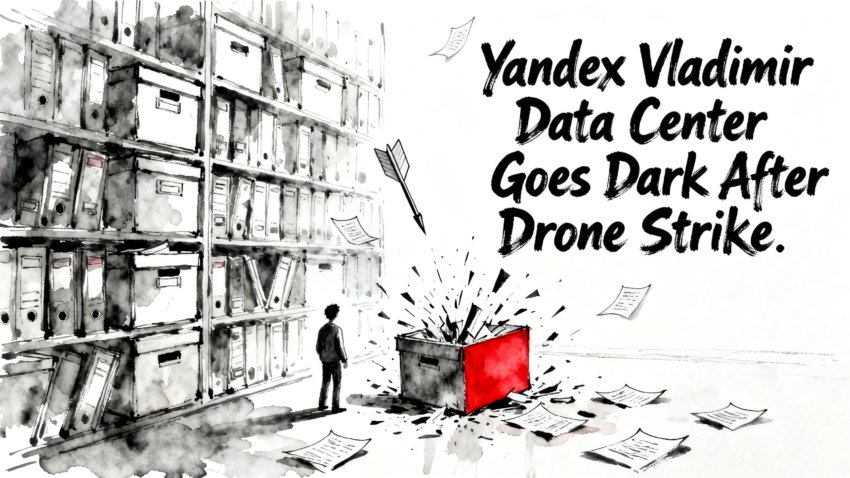
Yandex Vladimir Data Center Goes Dark After Drone Strike
Smoke Over Vladimir: A Drone Strike Takes the Yandex Vladimir Data Center Offline
TL;DR
On October 11, 2026, a drone attack forced Yandex to halt all operations at its Vladimir facility, one of the company’s primary compute nodes northeast of Moscow. The shutdown cut access to dozens of cloud products, took the Galushkin AI supercomputer offline, and left developers without live YandexGPT API endpoints. Yandex described the situation as a suspension pending damage assessment, with no restoration timeline confirmed.
Quick Takeaways
- A drone strike on October 11, 2026 forced Yandex to suspend all operations at its Vladimir data center on the same day the attack occurred.
- United24 Media (2026) reported the Vladimir facility held a power capacity of approximately 56 megawatts, placing it among the larger commercial data centers in the Russian market.
- Galushkin, one of Yandex’s dedicated supercomputers for neural network training, was located at the Vladimir site.
- Reported disruptions spanned Compute Cloud, Object Storage, Managed Kubernetes, managed databases, developer tools, and the YandexGPT API.
- The Vladimir strike was reportedly the third hit on Yandex data center infrastructure within four days, per United24 Media (2026), pointing to a coordinated targeting pattern rather than an isolated incident.
What Happened at Yandex’s Vladimir Data Center on October 11, 2026
Yandex suspended all operations at its Vladimir data center on October 11, 2026, after a drone strike caused physical infrastructure damage at the facility. Yandex is one of Russia’s largest technology companies, operating search, maps, cloud computing, and AI services across Russia and several regional markets. The Vladimir data center was a primary site: it handled a meaningful share of Yandex Cloud’s eastern compute load and housed dedicated AI training hardware that supported the company’s language model development.
The city of Vladimir sits roughly 200 kilometers northeast of Moscow in Vladimir Oblast, offering proximity to Moscow’s enterprise customer base while keeping operational costs lower than in the capital. Losing the Vladimir facility stripped Yandex Cloud of both latency value and redundancy capacity at once.
The Vladimir strike was reportedly the third attack on Yandex data center infrastructure within four days, set against the ongoing conflict between Russia and Ukraine, suggesting commercial compute assets have become a deliberate targeting focus rather than incidental collateral damage.
How the Drone Strike Disrupted AI Compute Operations
The Yandex Vladimir data center hosted both AI training and inference infrastructure, meaning the October 11 drone strike disrupted model development and production developer services at the same time. Large-scale AI training requires sustained, high-density power delivery to keep GPU clusters running without interruption; even a brief power or cooling disruption forces workloads to checkpoint and restart, wasting hours of accumulated compute. A full shutdown halts active training jobs entirely until engineers can safely assess and restore the physical site.
Galushkin, one of Yandex’s dedicated supercomputers for neural network training, was among the hardware taken offline. Removing it from the training pool does not reduce output proportionally; pipeline bottlenecks cascade, and teams mid-run must choose between resuming on reduced capacity, delaying until restoration, or migrating jobs to the remaining clusters.
Inference infrastructure serving live API calls was also caught in the outage. Because inference and training clusters share the same building, power circuits, and network fabric, facility-level damage brings both down simultaneously, which is why the outage reached past the AI research layer into production developer services.
Did You Know
Yandex builds and operates its own specialized hardware for AI model training rather than sourcing capacity from third-party hyperscalers. Running proprietary supercomputer clusters on self-owned infrastructure gives Yandex tighter control over training throughput and model iteration cycles, but it also means that physical damage to a single site has no external fallback layer. There is no equivalent to spinning up replacement capacity in a public cloud marketplace when the hardware itself is custom-built and physically located inside a damaged building.
Yandex Cloud Outage: 80+ Services Disrupted, Including YandexGPT API
More than 80 Yandex Cloud services were disrupted by the Vladimir strike, according to Kyiv Post (2026), affecting developers, businesses, and automated workflows across the platform. Disrupted services included Compute Cloud (virtual machines and bare-metal instances), Object Storage (a foundation layer for data pipelines and model artifact storage), Managed Kubernetes (container orchestration used in many MLOps pipelines), managed databases, and developer tooling.
The YandexGPT API was among the disrupted endpoints. Developers who had integrated it into production applications, chatbots, or automation pipelines saw live endpoints returning errors, with downstream applications degrading visibly, surfacing error messages to end users, or failing silently depending on each team’s error handling.
Reported Yandex Cloud Service Disruptions
| Service | Category | Reported Status | Common Dependency |
|---|---|---|---|
| Compute Cloud | Compute | Suspended | VM workloads, ML training jobs |
| Object Storage | Storage | Disrupted | Data lakes, model artifact storage |
| Managed Kubernetes | Orchestration | Disrupted | MLOps pipelines, containerized apps |
| YandexGPT API | AI / LLM | Disrupted | Chatbots, NLP automation, RAG apps |
| Managed Databases | Database | Disrupted | Transactional apps, analytics backends |
| Developer Tools | CI/CD | Disrupted | Deployment pipelines, observability stacks |
Reported disruptions per Kyiv Post (2026) and Yandex status communications.
Why Galushkin Matters to Yandex’s AI Strategy
Galushkin sits at the center of Yandex’s language model development pipeline, also supporting image recognition systems and personalization engines. Its loss removes dedicated training throughput that cannot be instantly redistributed; workloads interrupted mid-run carry accumulated restart costs that extend the delay beyond a simple capacity reduction, and timeline slippage compounds with each run that must restart from an earlier checkpoint.
YandexGPT’s development cycle depends on the Galushkin training pipeline. Each model iteration requires sustained training runs followed by evaluation rounds, safety testing, and fine-tuning passes. Interrupting that cycle mid-flight wastes accumulated compute and delays release timelines, with commercial consequences for enterprise customers with contracted expectations around model improvements or API versioning.
Yandex’s AI development roadmap depends on keeping model quality competitive against both international peers and domestic challengers. Losing training capacity opens a window during which rivals iterate while Yandex’s pipeline sits idle, and closing that gap after restoration requires revalidating work interrupted mid-run, not just catching up on lost training runs.
AI Infrastructure Resilience: Lessons from the Yandex Vladimir Outage
The Yandex Vladimir outage demonstrates what happens when AI workloads depend on a single cloud region: services stop, pipelines stall, and recovery timelines are set by the provider’s situation rather than the customer’s operational priorities.
The core problem for most teams is not undocumented recovery policy but untested recovery policy. Runbooks written for hypothetical outages omit the specifics that matter during an actual incident, and backup procedures never executed rarely behave as expected under pressure. Simulate the outage, follow the documented steps, and measure actual recovery time against the stated recovery time objective; the gap between those numbers is the real exposure.
Geographic distribution is the structural answer to physical data center risk. Running AI inference across at least two independent availability zones, with automated health checks and programmatic traffic rerouting, means physical damage to one site triggers a predetermined response rather than a manual scramble. That architecture carries higher baseline operating costs, but substantially lower costs than an unplanned outage measured in days rather than minutes.
Did You Know
Cloud availability zones protect against hardware failure and maintenance windows, not against physical damage to the data center building itself. A strike that disables power, cooling, or structural integrity can force an outage that no software-level redundancy prevents. This is why geographic multi-region deployment (separate facilities in separate locations) is the meaningful unit of resilience for high-stakes AI workloads, not just multi-zone deployment within a single site.
What Yandex’s Recovery Effort Could Involve
Yandex confirmed that operations at the Vladimir site were suspended for damage assessment, with no restoration timeline announced. Physical infrastructure recovery of this kind typically unfolds across three distinct phases before production workloads can return: structural and safety evaluation of the building itself, hardware inspection and damage triage at the equipment level, and staged restoration of power, cooling, and network connectivity.
Hardware inspection is typically the most time-consuming phase. Equipment exposed to physical trauma, power surges, fire suppression discharge, or water ingress may appear undamaged while carrying faults that surface only under load. Skipping full diagnostics on server clusters, storage arrays, and networking infrastructure risks cascading failures once workloads resume, extending the outage well beyond the original incident window.
Recovery of the Galushkin supercomputer is more complex than commodity server replacement. Custom AI training hardware is not stocked at distributors; repair of damaged components involves specialized parts, vendor coordination, and integration testing before the machine can rejoin a training cluster. Yandex’s engineering teams likely face three concurrent options: restore the Vladimir site, redistribute capacity to the remaining clusters, or accelerate procurement of replacement hardware.
Customers evaluating their own exposure can use Yandex Cloud’s documentation on multi-region configurations as a reference while the restoration process continues. The practical question after this event is not whether Yandex will recover its infrastructure, but whether each team’s own workloads can sustain independent operations for however long that recovery takes.
Five Steps to Protect AI Workloads Against Data Center Outages
Each step below addresses a specific failure mode the October 11, 2026 outage exposed and is worth completing before a provider-side incident forces the question.
- Produce a written map of every AI workload and its physical availability zone. List each inference endpoint, training job, data pipeline, and storage bucket with the zone or facility it depends on. This audit commonly surfaces hidden single points of failure never flagged during original deployment.
- Write restore runbooks and then run a timed drill against them. Record actual recovery time for each service category: models, databases, object storage, Kubernetes configurations. Treat the gap between measured time and your recovery time objective as a backlog item, not a planning note.
- Provision a secondary compute environment and keep it warm. A secondary environment on a different cloud provider or in a geographically separate region with the same provider needs to be running and validated, not just documented. Cold standby that has never served traffic rarely behaves as expected on the day it must.
- Set programmatic migration triggers before any incident occurs. Define the monitoring thresholds (error rate, latency, availability checks) that automatically initiate traffic rerouting to secondary infrastructure; reactive decisions during a live outage are slower and more error-prone than thresholds encoded in advance.
- Document the full cascade from your AI APIs outward. Map every downstream service your AI endpoints touch: identity providers, object storage buckets, vector databases, logging pipelines, and monitoring stacks. A YandexGPT API failure that cascades into dependent services only reveals its full blast radius when the dependency graph is written before the outage, not reconstructed during it.
Conclusion
The October 11, 2026 drone strike on the Yandex Vladimir data center confirms that AI infrastructure depends on physical facilities that can be damaged or destroyed. Taking Galushkin offline illustrates a structural vulnerability that any organization building on cloud-hosted AI compute needs to address. Resilience planning that exists only in documentation is not resilience; it is deferred risk.
Multi-region deployment, tested recovery procedures, and pre-defined failover triggers are not theoretical recommendations from a vendor whitepaper. After October 11, 2026, they are the observable difference between teams that remained operational and teams that waited for a provider’s status page to tell them when services would return.