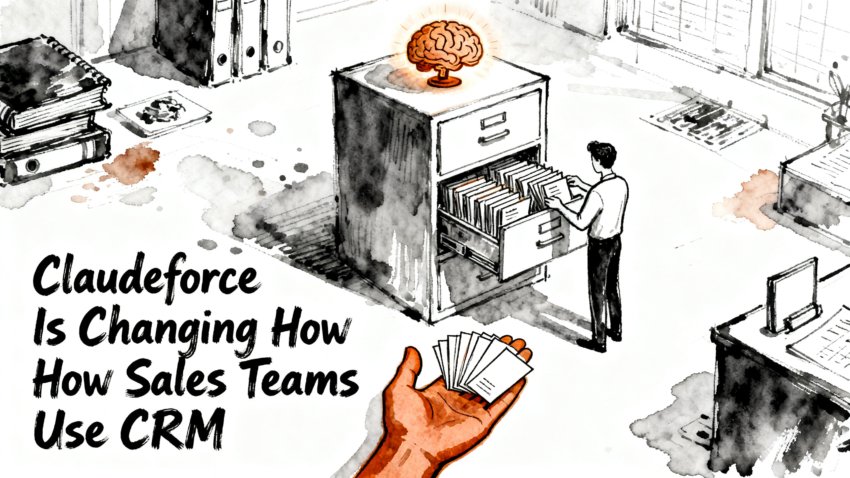
Claudeforce Is Changing How Sales Teams Use CRM
Claudeforce: The Salesforce Anthropic Partnership Embedding Claude Into Enterprise CRM
Claudeforce is the expanded partnership between Salesforce and Anthropic that puts Claude’s reasoning directly inside Salesforce’s CRM platform, governed by the same permission structure your sales team already operates under. Announced on August 26, 2026, it moves AI from a separate browser tab to live pipeline data inside existing workflows, with every action staying within the enterprise governance boundary.
TL;DR
- Salesforce and Anthropic announced Claudeforce, a deepened partnership embedding Claude into Salesforce CRM and the Agentforce agentic platform.
- The centerpiece is Salesforce in Claude: a plugin with 37 prebuilt sales skills that lets reps work with live Salesforce data without leaving Claude.
- Claude is now a preferred model for Agentforce, giving developer teams a high-capability reasoning option for building custom sales agents.
- Open beta launches September 2026; pilot access is already live for select customers.
- Regulated industries including financial services, healthcare, cybersecurity, and life sciences are the primary enterprise targets.
Quick Takeaways
- Claudeforce is the partnership brand name, not a separate standalone product.
- Salesforce in Claude connects 37 prebuilt sales skills to live CRM data through a governed plugin.
- Claude joins Agentforce as a preferred AI model, expanding the October 2025 integration reported by Reuters.
- All plugin actions stay within existing Salesforce role-based permission boundaries.
- The pilot-to-open-beta window (August to September 2026) is the right time to audit CRM data quality before rollout.
What Salesforce and Anthropic Announced on August 26, 2026
On August 26, 2026, Salesforce and Anthropic published the Claudeforce announcement describing two primary components: Salesforce in Claude, a plugin that brings live CRM data and governed actions into the Claude interface, and a formal designation of Claude as a preferred AI model for Agentforce, Salesforce’s platform for building and deploying autonomous agents.
As Reuters reported in October 2025, Salesforce had already named Claude as one of several AI model options available through Agentforce and Einstein Studio, alongside OpenAI’s models. The 2026 Claudeforce announcement deepens that relationship: Claude moves from one option among many to a preferred model, and Salesforce in Claude adds a dedicated interface-level presence the 2025 integration did not include. The full announcement is on both the Salesforce investor relations page and the Anthropic news blog.
Salesforce, headquartered in San Francisco, is widely recognized as one of the largest CRM vendors by market share. Anthropic, also based in San Francisco, is the AI safety company that built the Claude model family. Anthropic has received significant investment from Amazon, and Salesforce has been a major AWS customer for years, giving the partnership a shared cloud infrastructure foundation that matters for enterprise data residency requirements.
What Claudeforce Changes for Enterprise CRM Workflows
Claudeforce eliminates the parallel-track split between CRM data and AI tools that most enterprise sales teams operate under today. Before Claudeforce, sales teams updated Salesforce, switched to a separate AI tool to draft outreach or summarize a call, then returned to Salesforce to log the result. Claudeforce collapses that switching cost: reviewing a priority account, generating tailored outreach based on that account’s history, and logging the activity back to Salesforce can all happen within a single Claude conversation.
For sales operations and revenue operations leaders, the structural shift is more significant. When AI can reason over aggregated pipeline data within the same access controls as a human analyst, routine pipeline reviews, forecast briefings, and risk-flagging start to look like automatable workflows rather than weekly manual exercises. Claudeforce does not eliminate human judgment; it reduces the time tax on the humans doing the judging.
How Salesforce in Claude Works: 37 Prebuilt Skills and Governed Data Access
Salesforce in Claude is a plugin with 37 prebuilt sales skills that lets users reason over live Salesforce context, update pipelines, and take governed actions directly inside Claude.
The 37 prebuilt skills cover the core mechanics of a sales workflow: pulling account and opportunity data, drafting outreach based on CRM context, updating deal stages, summarizing call notes and logging them directly to Salesforce, and surfacing relevant contacts and activity history. Because Salesforce in Claude connects to live Salesforce data rather than a static export, the context reflects your pipeline’s current state, not a snapshot from earlier in the week.
Governance is built into the architecture from the start. Salesforce in Claude inherits Salesforce’s existing permission structure, meaning a sales rep can only access records their Salesforce profile already permits. For enterprise buyers asking whether the Claudeforce integration adds new data risk, the answer is governed access, not open access.
Did You Know?
Salesforce in Claude is designed as a plugin within the Claude interface, meaning sales reps using it do not need to adopt a new Salesforce-native AI tool or modify their existing Salesforce configuration. The AI meets the team in the interface many enterprise professionals are already using daily, rather than requiring a separate product adoption cycle.
Salesforce in Claude requires a connection to an existing Salesforce org. The permission model your Salesforce admin has already configured determines what context the model can access and what actions it can execute. Rollout readiness is largely a CRM hygiene question: how complete and consistent is your existing Salesforce data? The integration itself is not the hard part.
Why Claude’s Preferred Agentforce Status Matters for Developer Teams
Agentforce is Salesforce’s platform for building, deploying, and managing AI agents that take actions inside Salesforce autonomously or on behalf of users. Designating Claude as a preferred model for Agentforce gives development teams a high-capability reasoning option when they build custom sales agents on the platform, with the documentation support and tooling optimization that preferred status implies.
The distinction between “available model” and “preferred model” is real in practice. A preferred model is one the platform vendor is actively optimizing for, surfacing in default configurations, and supporting through documentation and integration testing. For teams building on Agentforce, Claude as a preferred model means fewer edge cases in the builder experience, not just a wider model menu.
Einstein Studio, Salesforce’s environment for customizing AI models used in the platform, was the original entry point for Claude following the 2025 partnership. The 2026 Claudeforce expansion extends Claude’s reach from a configurable model option into a preferred Agentforce model and a dedicated interface plugin, broadening use cases significantly without requiring those teams to rebuild integrations from scratch.
Claudeforce Use Cases: Sales Teams and Regulated Industries
For a typical outbound sales rep, Claudeforce means pipeline management without context switching. Reviewing the week’s priority opportunities, drafting personalized outreach based on account history, and logging call notes to CRM becomes a single conversation flow rather than separate tool interactions split across Salesforce and a standalone AI session.
For revenue operations teams, the value shifts toward aggregated pipeline reasoning. Claude can review deal data across a territory or segment, surface opportunities showing risk indicators based on activity patterns, and generate briefings that would otherwise take an analyst hours of manual data gathering to compile.
Salesforce and Anthropic have specifically named financial services, healthcare, cybersecurity, and life sciences as the regulated industries this integration is built for. The common thread across those four verticals is strict data handling requirements that create friction in standard AI tool deployments. The governance model keeps all data access within the existing Salesforce permission layer, providing a compliant path to AI-assisted CRM workflows that many enterprise buyers in those industries could not previously clear.
A financial services firm might use Claudeforce to help relationship managers review client holdings and interaction history before a call, with every AI-assisted action logged in Salesforce and bounded by the same access controls as a human analyst. A healthcare organization’s commercial team might surface account histories for provider outreach, with no patient data in scope because the Salesforce permission model already excludes it from the rep’s profile.
Did You Know?
Slack, which Salesforce acquired in 2021, is part of the same enterprise AI ecosystem. The current partnership is focused on CRM-layer integration, but the Slack surface is a natural extension point as Agentforce agents expand across enterprise communication and collaboration tools.
Claudeforce Launch Timeline: Pilot Access Now, Open Beta September 2026
Salesforce in Claude is available to select pilot customers as of the August 26, 2026 announcement. Open beta is expected in September 2026, according to the joint announcement from Salesforce and Anthropic. Claude as a preferred model for Agentforce is available now for any Salesforce customer with existing Agentforce access.
For teams evaluating Claudeforce, the pilot-to-open-beta period between August and September 2026 is useful planning time. Mapping your existing Salesforce permission model to the plugin’s access patterns, identifying the workflow where context switching costs your team the most, and running a basic CRM data quality audit will position your team to extract real value when open beta arrives, rather than discovering those gaps after rollout has started.
Two Ways to Use Claude in Salesforce
| Agentforce + Einstein Studio | Salesforce in Claude | |
|---|---|---|
| Primary audience | Developers and AI teams | Sales reps and managers |
| Interface | Salesforce platform | Claude interface |
| Primary use | Build custom AI agents | Daily sales workflow tasks |
| Skills at launch | Custom-built per use case | 37 prebuilt |
| Setup requirement | Developer configuration | Plugin connection |
| Governance model | Salesforce permissions | Salesforce permissions |
| Availability | Available now | Open beta September 2026 |
Claudeforce and Enterprise AI Strategy: Why CRM Data Quality Determines ROI
The Salesforce Anthropic Claudeforce partnership bridges two levels of enterprise AI strategy that rarely connect cleanly: the infrastructure level (which models, which APIs, which governance framework) and the workflow level (what individual contributors need to do faster or better).
Salesforce brings the workflow layer: data, pipelines, permissions, and the established processes sales teams already run inside CRM. Anthropic brings the reasoning layer: a model capable of handling complex, multi-step sales contexts without requiring users to engineer every prompt from scratch. Combining them inside a governed integration makes a more credible enterprise AI story than either component delivers in isolation.
For AI strategy leads and sales technology owners, the Salesforce Anthropic partnership raises a useful clarifying question: where does your team already have strong data discipline inside Salesforce? That is exactly where an integration like Claudeforce delivers the fastest return. Clean, consistently structured CRM data gives Claude context it can reason over meaningfully. Incomplete pipeline data, inconsistent stage definitions, and sparse activity logs produce thin AI output regardless of how capable the underlying model is.
How to Prepare for Claudeforce Before the September 2026 Open Beta
If you manage a sales team or own the sales technology stack, here is how to approach the Claudeforce open beta.
Start with a CRM data quality audit before September 2026. Activity logging completeness, opportunity stage discipline, and contact data coverage are the three variables that most directly determine how much real reasoning value Claude can extract from your pipeline. If your reps log calls inconsistently or skip stage updates, the model has thin context to work with, and the output will reflect that clearly.
Identify one workflow where context switching is a measurable cost. Pre-call account review and pipeline update sessions are common starting points. The 37 prebuilt Salesforce in Claude skills cover both directly. Picking one to pilot before a broad rollout gives you a meaningful comparison and surfaces integration issues before they affect your whole team at once.
Work with your Salesforce admin to map current permission structures against the Salesforce in Claude plugin’s access model. The governed nature of the integration means you are operating within existing rules, not building new ones. Any gaps in your current Salesforce permissions will surface when the AI reaches a record it cannot access. Better to find those during a controlled pilot than at full scale.
Conclusion
The Salesforce Anthropic partnership has moved from a model option in a vendor menu to a structural integration with its own brand name, a dedicated plugin, and a preferred model designation inside Agentforce. Claudeforce is not a feature update; it is a repositioning of how enterprise CRM connects to AI reasoning at the workflow level.
For sales leaders, the question this announcement should prompt is not whether to pay attention. The question is whether your Salesforce instance is structured well enough to extract value when open beta arrives in September 2026. The reasoning capability is ready. The real variable is your CRM data.