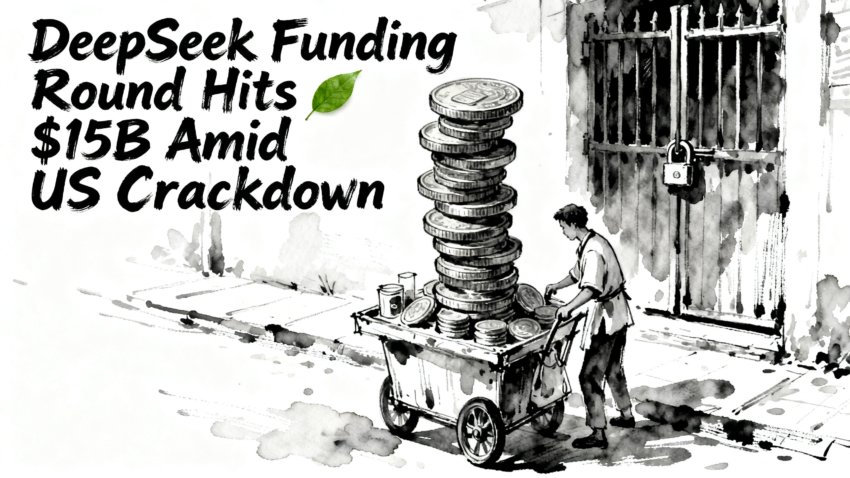
DeepSeek Funding Round Hits $15B Amid US Crackdown
DeepSeek Raises $15 Billion in China’s Boldest AI Bet Yet
TL;DR
DeepSeek secured its largest reported funding round in October 2026, positioning the Hangzhou lab as a direct challenger to leading US AI labs. Reported investors include battery maker CATL and tech conglomerate Tencent. US federal restrictions target government deployments and do not constitute a universal ban for commercial users. Capital is expected to flow toward data centers, open models, and international expansion. A domestic IPO is reportedly under consideration.
Quick Takeaways
- DeepSeek’s October round ranks among the largest single AI financings in Chinese technology history.
- A prior June round already established DeepSeek’s trajectory as a heavily funded lab with a major capacity mandate.
- Reported investors CATL and Tencent bring strategic infrastructure links alongside capital.
- US federal restrictions are scoped to government deployments, not a blanket prohibition on commercial or developer use.
- A domestic IPO reportedly under consideration would introduce public disclosure requirements for the first time.
What DeepSeek’s $15 Billion Funding Round Means
In October 2026, DeepSeek reportedly closed a financing round of approximately 100 billion yuan ($15 billion), as Bloomberg described, placing the Hangzhou-based AI research lab among the best-funded AI ventures in the world. A Chinese lab operating under significant US export restrictions has assembled capital large enough to build compute infrastructure at hyperscaler scale.
Washington’s tightened export restrictions have not prevented private Chinese capital from stepping in at a scale that partially offsets hardware access constraints. For enterprise teams, the round signals that the lab’s operating runway has lengthened considerably, regardless of what further restrictions may follow.
The October round was not DeepSeek’s first major financing of the year. TechCrunch reported in 2026 that DeepSeek had already raised more than $7 billion in a June round at a valuation of $50 billion. The October capital roughly doubles the total assembled within a single calendar year, placing DeepSeek among the most heavily funded AI labs to emerge outside the United States.
Who Invested in DeepSeek and Why
Reported investors include Contemporary Amperex Technology (CATL), one of the world’s largest electric vehicle battery manufacturers, and Tencent Holdings, one of China’s dominant technology conglomerates. Final investor lists and allocation sizes have not been confirmed publicly.
CATL’s participation signals more than a financial bet on AI returns. Battery manufacturers are embedding AI into energy management, predictive maintenance, and manufacturing quality control. A stake in a lab producing some of the most compute-efficient open-weight models gives CATL proximity to a research agenda that intersects with its own automation roadmap.
Tencent follows its familiar pattern of placing bets across AI infrastructure and applications. DeepSeek’s open-model approach, with research available through arXiv preprints and public repositories, lowers integration costs compared to licensing from a closed-model provider, giving the stake clear near-term commercial rationale.
Rounds of this magnitude in China likely involve sovereign or quasi-sovereign capital, though backers have not been disclosed, given Beijing’s AI self-sufficiency priority. That context makes DeepSeek a strategically significant national asset, explaining why substantial capital arrived despite geopolitical headwinds.
Did You Know?
DeepSeek’s open-weight models have been downloaded by developers across the United States, Europe, and Southeast Asia, giving the lab a global technical footprint that funding figures alone do not capture. Background on the lab’s history and model releases is available at the DeepSeek Wikipedia entry.
How US Restrictions on DeepSeek Work: Scope and Limits
US restrictions cover government deployments, not all commercial or developer use. Federal civilian agencies were directed to remove DeepSeek software from government systems, a scope limited to the federal estate. That distinction matters for enterprise teams determining whether restrictions apply to their environment.
The Bureau of Industry and Security (BIS), which maintains documentation at bis.gov, has progressively tightened restrictions on advanced chip exports to China, limiting DeepSeek’s access to the newest Nvidia and AMD accelerators. The lab has attributed part of its efficiency advantage to this constraint: when frontier hardware is off the table, algorithmic efficiency becomes the main competitive lever.
The Congress.gov docket contains multiple bills targeting Chinese AI platforms in federal procurement, though passage timelines vary by chamber and legislative calendar. Enterprise legal teams should monitor that docket directly, given how quickly AI-related bill priorities have shifted.
For private sector operators outside federal procurement, current restrictions create caution rather than a hard legal barrier. Many compliance-aware organizations are auditing workflows and documenting data flows in anticipation of future regulatory changes. Over the past eighteen months, informal guidance has hardened into formal procurement restrictions, and that trajectory is likely to continue.
Where DeepSeek May Spend the New Capital
Data center build-out is the most capital-intensive near-term priority. Training frontier models requires tens of thousands of accelerators; the October round provides runway to construct or lease capacity competitive with AWS, Microsoft Azure, or Google Cloud, even while the newest chip generations remain constrained by export controls.
Open-model research is core to DeepSeek’s identity. The lab built credibility by releasing model weights and technical papers rather than locking everything behind a proprietary API. Sustaining that cadence requires compute budget and research staffing; the new round addresses both.
International expansion has clear strategic logic. DeepSeek’s models are already deployed across Southeast Asia, Europe, and Latin America as cost-efficient alternatives to OpenAI or Anthropic. Building sales, legal, and compliance infrastructure in those markets requires investment the October round now provides.
AI safety and compliance programs form a fourth spending category that cannot be deferred. The EU AI Act and analogous frameworks in Singapore, the United Kingdom, and Japan require documented risk assessments, governance structures, and transparency reports. Capital here is an access prerequisite for regulated markets, not a discretionary expense.
Implications for China’s AI and Automation Market
DeepSeek’s round confirms that open-model development at the frontier is financially viable outside the US tech ecosystem. China’s domestic AI market has accelerated under government industrial policy, a large engineering talent base, and growing enterprise automation demand. DeepSeek’s capital raise shows Chinese AI labs can earn institutional confidence even under sustained geopolitical pressure.
Competition within China is contested. Baidu’s Ernie platform, Alibaba’s Qwen model family, and ByteDance’s AI research operation all compete for enterprise contracts and developer mindshare. DeepSeek’s open-weight strategy distinguishes it from Baidu and Alibaba’s closed commercial APIs, while ByteDance’s AI capabilities remain integrated into its own product ecosystem.
Did You Know?
DeepSeek’s published training techniques have reportedly been cited as reference points by researchers at major US AI labs, illustrating how open research creates competitive knowledge transfer across geopolitical lines. The lab’s technical preprints are indexed on arXiv and freely accessible to any researcher worldwide.
For automation practitioners outside China, the implication is cost trajectory and vendor diversification. Open-weight DeepSeek models can be self-hosted, eliminating per-token API charges. A manufacturer running quality inspection or a logistics company processing large document volumes has a materially different cost structure self-hosting versus paying per token at scale. The new capital signals open-weight releases will continue, expanding enterprise choice.
DeepSeek’s Potential IPO and Global Expansion
DeepSeek is reportedly considering a domestic China IPO, which would establish a public valuation benchmark and introduce financial disclosure requirements. A listing would provide liquidity for early investors and subject the lab to disclosures covering revenue, operating margins, and customer concentration.
An IPO conducted while US restrictions remain active and technology decoupling uncertainty persists requires careful framing for institutional investors. Chinese technology listings have faced valuation pressure as overseas funds reassessed China-specific risk. A lab with substantial private backing and technically influential open research presents a different investment case than earlier Chinese platforms that listed on pure growth multiples.
Global expansion is already advancing. DeepSeek’s API products and open models, available at deepseek.com, have attracted integrations from automation vendors across Europe, the Middle East, and Southeast Asia. For enterprise buyers, the question is no longer whether to evaluate DeepSeek but how to structure that evaluation within local regulatory frameworks. The new funding makes long-term vendor viability a more defensible assumption.
DeepSeek vs. Leading AI Labs: Strategic Comparison
| Dimension | DeepSeek | OpenAI | Anthropic | Google DeepMind |
|---|---|---|---|---|
| Model access | Open-weight and API | Closed API only | Closed API only | Closed API (Gemma family open) |
| Primary funding source | Private Chinese investors; reported sovereign participation | Microsoft; venture capital | Amazon; Google; venture capital | Alphabet (parent company) |
| Hardware access | Restricted; efficiency-focused approach | Full Nvidia stack access | Full Nvidia stack access | Google TPUs and Nvidia hardware |
| US regulatory exposure | High; federal procurement restrictions active | Low | Low | Low |
| Self-hosting option | Yes, open-weight models available | No | No | Limited (Gemma family only) |
| IPO status | Reportedly under consideration | Planned but unconfirmed | Private; no announced plans | Subsidiary; not separately listed |
How to Evaluate DeepSeek for Your Organization
DeepSeek’s $15 billion capital base means the lab will remain a significant model provider for the foreseeable future. That shifts the evaluation question from whether this vendor is viable to how DeepSeek fits your specific compliance and performance requirements.
Verify whether the October 2026 round has formally closed before citing DeepSeek’s financial position in procurement documents. Bloomberg’s reporting is credible, but procurement committees typically require confirmed closing dates and final investor lists before treating a vendor as financially stable for multi-year contracts.
Assess regulatory exposure before committing to production deployment. US federal contractors face the clearest active restrictions. Private sector organizations in healthcare, finance, or defense-adjacent industries should obtain legal counsel before deploying DeepSeek in workflows handling regulated data. EU-based organizations must satisfy the AI Act’s risk classification and documentation standards regardless of model vendor.
Evaluate self-hosted models against your actual workloads rather than published benchmarks. Benchmark scores reflect curated conditions; a document classification pipeline, customer query handler, or inventory forecasting workflow will respond differently based on hardware and prompt patterns. A structured pilot against a real-world sample is the only reliable way to establish production readiness.
- Set a quarterly reminder to review regulatory developments from the BIS, relevant congressional committees, and the EU AI Office; the policy environment shifts faster than annual vendor reviews can capture.
- Document all data flows touching any DeepSeek endpoint during initial deployment rather than retroactively; proactive documentation reduces compliance risk significantly.
- Build separate cost models for API access and self-hosting for each major workflow; the two options carry different latency profiles, MLOps overhead, and dependency risks that a blended cost figure will not reveal.
What DeepSeek’s Funding Means for AI Practitioners
DeepSeek’s October 2026 financing cements the lab as a credible long-term contender in the global AI infrastructure market. For practitioners, that means a structured evaluation process, a formal compliance review, and ongoing policy monitoring in a regulatory environment that legislators on both sides of the Pacific are still writing.
Build AI infrastructure decisions to accommodate that continuing uncertainty. Vendor diversification, documented data flows, and regular policy reviews are not defensive postures; they’re baseline operational hygiene for any team deploying AI at production scale in a market where the competitive and regulatory picture changes quarter by quarter.