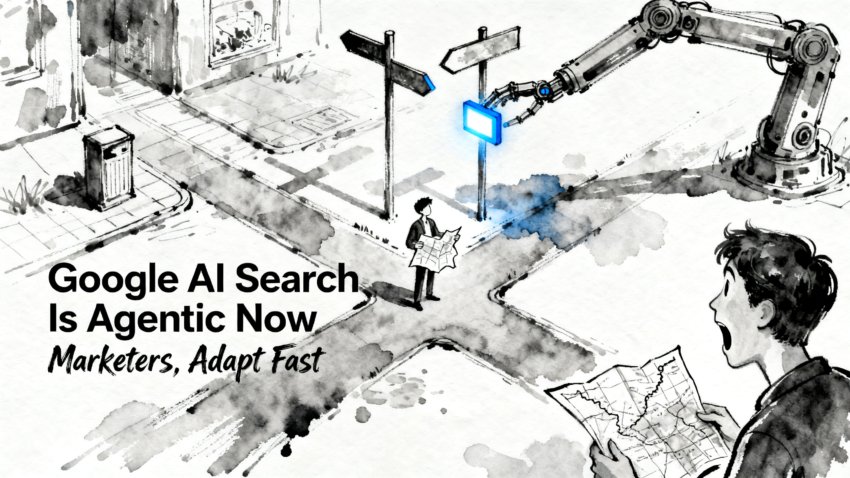
Google AI Search Is Agentic Now: Marketers, Adapt Fast
Google AI Search Is Now an Agentic Platform: The Marketing Reckoning
TL;DR
Google has transformed Search from a link index into an agentic platform powered by Gemini 3.5 Flash. AI agents now complete tasks, Antigravity mini-apps give brands a new owned channel inside Search, and Gemini Spark conducts buyer research proactively around the clock. Optimizing for clicks is no longer enough. You need to be cited, visible, and present where decisions actually get made.
Quick Takeaways
- Google replaced its default Search reasoning engine with Gemini 3.5 Flash, enabling a one-million-token context window and real-time agentic reasoning across every query.
- AI agents inside Google Search now complete bookings, comparisons, and purchases without users ever visiting your website.
- Antigravity mini-apps let brands build lightweight interactive experiences that live directly inside Search results as a new owned channel.
- Gemini Spark, a personal AI agent tied to Google accounts, is changing how buyers and journalists research brands continuously and proactively.
- SEO, paid search, and content strategy all require immediate recalibration to maintain visibility in an agent-first Search environment.
What Google’s Agentic Search Transformation Is and Why It Breaks the Old Bargain
For three decades, Search operated on a simple bargain: surface relevant links, and users click through to websites for their answers. Publishers, advertisers, and brands built their entire digital strategies around that bargain. It is now broken. Google Search has shifted from a link-retrieval system to an agentic AI platform that reasons, plans, and completes tasks on users’ behalf. This is not a gradual evolution but a categorical shift in what Search actually is.
The transformation is visible in two places: AI Mode, the default search experience now powered by Gemini 3.5 Flash, and the ecosystem of agents and mini-apps operating within and alongside the core Search interface. Together, they form a system designed to complete user tasks, not route users elsewhere to complete them.
What makes this structurally different from previous algorithm updates is the change in what the system considers a successful outcome. Ranking-based Search measured success by surfacing a useful link. Agentic Search measures success by completing the user’s task, which may involve no outbound link at all. That one change reverberates through every marketing channel in use, and organizations that recognize it earliest will have the most room to adapt before competitive dynamics harden.
Gemini 3.5 Flash as Google’s Default Search Reasoning Engine: Business Stakes
Gemini 3.5 Flash is the model Google deployed as the default reasoning engine for AI Mode. According to the Gemini 3.5 family launch announcement, this generation was built to handle the mix of speed, scale, and multi-step reasoning a live search environment requires.
Gemini 3.5 Flash supports a one-million-token context window, meaning it can ingest a full product catalog, competitor pricing pages, third-party review aggregators, and recent news coverage simultaneously within a single search session. What the model synthesizes from that context is what the user sees: a grounded, reasoned answer with attributed sources, not a ranked list of links. The Google DeepMind Gemini Flash overview notes the model was designed specifically for high-volume, latency-sensitive tasks, exactly the profile of a live commercial search query at scale.
For businesses, the stakes come down to grounding accuracy. Incomplete schema markup, unstructured pricing data, and inconsistent brand information are no longer just SEO housekeeping issues. These gaps directly determine whether the model represents a brand accurately, incompletely, or not at all in AI-generated answers seen by thousands of buyers daily. Structured data is now a product asset, not an SEO afterthought.
AI Agents Inside Google Search: How Task Completion Replaces Click-Through
AI agents embedded in Google Search now complete multi-step tasks without users leaving the results page. These agents compare insurance plans, book restaurant reservations, filter product catalogs by technical specification, initiate software trials, and in select categories complete purchases, all without the user visiting any website.
This is the mechanism that fundamentally breaks the click-through model. Search engine optimization has historically been about earning the click: ranking high enough, crafting compelling title tags, writing meta descriptions that drive users to a page. When an agent intercepts that journey and completes the task at the SERP level, the click never happens and ranking position becomes irrelevant to the transaction.
The categories most exposed are those where user intent is task completion: e-commerce, travel and hospitality, local services, financial product comparisons, and software trials. For any business whose model depends on users arriving at a website to convert, the most urgent question is how many high-intent queries are now being resolved inside Search before they reach the site. Better keyword optimization will not fix this. The queries being intercepted are often the ones a brand ranks best for; they are intercepted precisely because they are high-intent and task-shaped.
Did You Know?
Google AI Mode uses a “query fan-out” technique: a single user query triggers multiple sub-queries running in parallel, each answered by Gemini 3.5 Flash, then synthesized into one unified response. Your brand may appear in a synthesized answer and influence a purchase decision without generating a single referral visit in your analytics platform. Traditional traffic metrics will increasingly undercount your real Search presence.
Antigravity Mini-Apps: How Brands Build an Owned Channel Inside Google Search
Google’s Antigravity mini-apps are lightweight interactive applications that brands build to live directly inside Search results, positioned between a traditional website and a paid ad, where buyer intent is highest.
The use cases are concrete. A mortgage lender can deploy a payment estimator users run inside Search without navigating away. A SaaS company can embed a product demo or ROI calculator. A retailer can surface a size guide or product configurator. A healthcare provider can offer a symptom checker or appointment scheduler. The Antigravity harness, built on the Gemini API with Gemini 3.5 Flash, lets developers create these experiences grounded in Search’s real-time context, so the mini-app behaves differently for a user in Boston researching mortgage rates than for one in Phoenix doing the same search.
Timing is the real strategic variable. Brands that move early will occupy premium real estate inside Search results in categories where they have not previously competed with Google’s own interfaces. Brands that wait will find that space claimed by competitors, aggregators, or Google’s AI-generated summaries. Platform windows of this kind close within a product cycle. For most marketing organizations, the immediate action is identifying which existing content formats (calculators, configurators, comparison tools, product demos) translate into a mini-app, then scoping the build with a development or agency team.
Gemini Spark: Google’s Proactive Personal AI Agent and What It Does to Buyer Research
Gemini Spark is Google’s personal AI agent, integrated with Search and tied to a user’s Google account, and it operates proactively rather than waiting for user-initiated queries. It monitors topics the user has expressed interest in, conducts ongoing research, compiles competitive profiles, and surfaces brand and product updates without requiring a new search. This changes how buyers form opinions before they ever contact a brand.
For B2B marketers, Gemini Spark changes the buyer research journey at its foundation. A procurement officer evaluating enterprise software no longer has to actively hunt for the latest case studies, pricing signals, or analyst coverage. Gemini Spark can compile a vendor comparison automatically and refresh it continuously. By the time that buyer enters a sales funnel, they may have more organized information about a company’s support reputation and competitive positioning than the seller’s own sales team surfaces in a discovery call. The information asymmetry that sellers once enjoyed has been permanently inverted.
The implications for PR are equally direct. Gemini Spark can conduct journalist and analyst research autonomously and deliver it on demand. A brand’s public record, including what the company has published, what reviewers have written, what executives have said in public forums, and what competitors claim, now feeds directly into the picture that buyers and journalists receive without any active media outreach. Managing that public record proactively and auditing it regularly through the same AI lens that stakeholders use is a core communications function with measurable business impact.
Did You Know?
Models like Gemini use retrieval-augmented generation to ground their answers in real-time web content, meaning the freshness, accuracy, and structure of your published content directly determines how you are represented in AI-generated answers. A well-marked-up product page updated last week will outperform a thin, unstructured page from last year in citation frequency, regardless of their respective organic ranking positions.
Winners and Losers in Agent-First Search: Which Businesses Are Most Exposed
The transition to agentic Search splits businesses along a single dividing line: whether a business depends on the click as the conversion mechanism, or whether it has presence inside the Search environment itself.
| Business Category | Impact | Core Reason |
|---|---|---|
| E-commerce (commodity products) | High negative | Agents complete price comparisons and initiate purchases without a site visit |
| Travel and hospitality | High negative | Booking tasks resolved at the SERP level; OTAs and brand booking pages lose direct clicks |
| Publishers and content sites | High negative | Informational queries answered directly; referral traffic drops without strong citation presence |
| Local services | Medium negative | Agent surfaces reviews, hours, and booking options inline; fewer clicks to service websites |
| B2B SaaS (complex sales) | Medium mixed | Long sales cycles limit full automation, but Gemini Spark reshapes the pre-funnel research phase |
| Brands with Antigravity mini-apps | Positive | Owned, interactive presence inside Search; user engagement without leaving results page |
| Brands with complete schema and structured data | Positive | Gemini accurately grounds answers about them; higher citation frequency in AI Mode responses |
| PR-mature brands with consistent public record | Positive | Gemini Spark surfaces them accurately to buyers and journalists without distortion |
Winners share investment in machine-readable content and owned presence within Search. Losers share structural dependency on the click as the primary measure of search visibility. Diagnosing honestly which category a business falls into is the prerequisite for making the right strategic moves before competitive dynamics calcify.
How SEO, Paid Search, and Content Marketing Must Change After Google’s Agentic Launch
SEO success in Google’s agentic Search is now measured by citation presence in AI Mode answers, not by ranking position. Earning a citation from Gemini 3.5 Flash requires content that is authoritative, specific, well-structured, and marked up so the model can accurately extract and attribute it. Thin content engineered for keyword density will not earn citations from a model evaluating source quality. The question to ask for every content asset is no longer “does this rank?” but “would a rigorous researcher cite this as a primary source?”
Paid search is entering a transition period that rewards active experimentation. Traditional keyword-triggered text ads continue alongside AI Mode results, but Google is developing AI Mode-specific ad placements structurally different from the existing format. Brands that test these early, before auction dynamics mature and costs climb, will accumulate placement advantages that competitors cannot replicate cheaply later. Budget previously allocated to broad keyword matching may deliver stronger returns redeployed into AI Mode ad products, particularly in categories where agentic task completion is already reducing organic click volume.
Content marketing faces the citation challenge with an additional strategic dimension: depth and specificity now matter more than topical breadth. Long-form content that demonstrates genuine expertise, cites verifiable data, names sources, and takes defensible positions is substantially more likely to appear in AI-generated Search answers than content designed to broadly cover a keyword cluster. Build the editorial calendar around citation potential, not coverage volume.
30-Day Action Plan: Adapting to Google’s Agentic Search
Start with an AI Mode audit of your most important commercial queries. Open Google’s AI Mode, run the queries that currently drive your highest-value organic traffic, and document whether agents are resolving those queries without a click. Identify where your brand appears in synthesized answers and where it is absent. This establishes a baseline for measuring business impact and pinpoints urgent content and structured data gaps. This audit should happen this week, not next quarter.
Next, address your structured data across every commercial page. Product pages, pricing information, organization schema, and FAQ content not marked up to current standards are functionally invisible to the grounding layer Gemini 3.5 Flash uses to answer commercial queries. A structured data audit against Google’s current documentation should go onto your engineering team’s backlog immediately, with priority proportional to the commercial value of the queries your AI Mode audit flagged.
For brands in categories where Antigravity mini-apps are viable (financial services, SaaS, retail, real estate, healthcare, professional services), brief your development team on the Gemini API this month. Identify which existing content formats translate into an interactive mini-app, scope the build with your product or agency team, and secure stakeholder buy-in before competitors move first. Treat this with the same urgency you would a new ad format in its early-access phase.
On the PR side, run a brand audit through the lens of what Gemini Spark would surface about your organization today. Search your brand, key executives, and flagship products in both AI Mode and Google’s Gemini interface directly. Note inaccuracies, gaps in coverage, and outdated information. The output should directly shape your press release calendar, executive thought leadership priorities, and review management strategy for the coming quarter.
Finally, reallocate a defined portion of your paid search budget to test AI Mode ad placements as Google makes them available in your region and vertical. CPMs and CPCs in these new formats will be lower in the early stages; the audience is high-intent by definition; and the testing data you accumulate now will be invaluable when planning your 2027 budget against a fully mature AI Mode ad marketplace.
Conclusion
Google’s agentic Search launch is a structural change to how commercial intent flows through the web’s dominant discovery channel, and the pace of that change is compounding, not stabilizing. Brands that treat this as an incremental SEO adjustment will find themselves progressively less visible in AI-generated answers and less relevant to buyers in a search environment that no longer measures success by clicks.
Brands that act now, auditing their AI Mode presence, fixing their structured data, exploring Antigravity mini-apps, and actively managing what Gemini Spark surfaces about them, will be in a materially better position than competitors when this transition accelerates. The early-access window in each of these channels will not stay open as adoption grows and costs rise to match the opportunity.