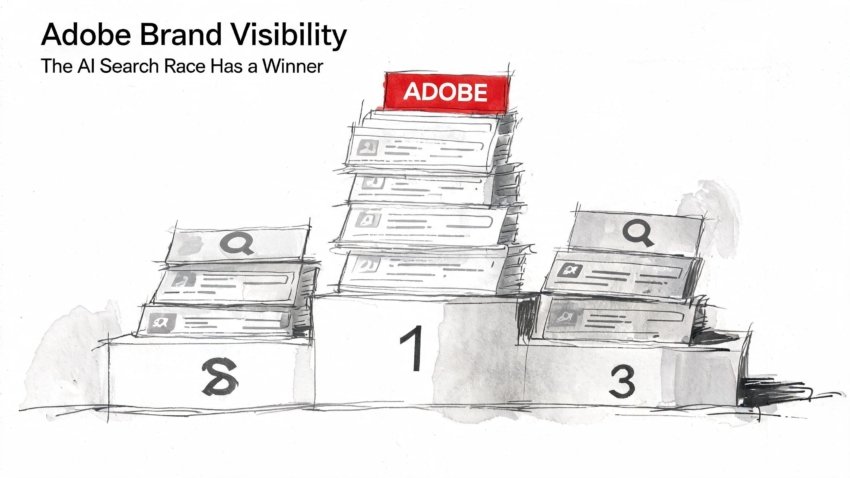
Adobe Brand Visibility: The AI Search Race Has a Winner
Adobe Brand Visibility: The First Enterprise GEO Platform for AI Citation Tracking
TL;DR
Adobe launched Brand Visibility on June 17, 2026, a generative engine optimization (GEO) platform inside Adobe CX Enterprise that tracks how often your brand is cited in AI-generated answers from ChatGPT, Google AI Overviews, Microsoft Copilot, and Perplexity. Built on Semrush’s data infrastructure and nearly 300 million real-world AI search prompts, it lets marketing, SEO, and PR teams measure share of voice in AI answers, identify content gaps, and deploy fixes at the CDN edge without engineering support. GEO is not replacing classical SEO; it is emerging as a parallel discipline with its own metrics, budgets, and optimization levers.
Quick Takeaways
- Adobe Brand Visibility is the first enterprise GEO platform to unify AI citation tracking, competitive benchmarking, and content deployment in a single closed-loop workflow.
- The platform covers ten LLM families including ChatGPT, Google AI Mode, Microsoft Copilot, and Perplexity, with competitive share-of-voice tracking against up to five direct rivals.
- Nearly 300 million consented real-world AI search prompts and Semrush’s 28.5-billion-keyword database power its predictive citation models.
- GEO is now a formal line item in enterprise marketing budgets, validated at Cannes Lions 2026 where Adobe presented it as a distinct answer-engine optimization category.
- Classical SEO signals including backlinks, structured data, and topical authority remain predictive inputs for AI citation outcomes, making GEO an evolution of SEO rather than a clean break from it.
Why AI-Generated Answers Are Replacing Blue-Link Search for Brand Discovery
AI-generated answers from ChatGPT, Google AI Overviews, Microsoft Copilot, and Perplexity have created a parallel discovery channel where brands are cited in conversational responses rather than ranked in blue links. When someone asks ChatGPT which project management tool to adopt, or prompts Google’s AI Overview to recommend a skincare brand for sensitive skin, they receive a synthesized response that may never surface a traditional results page at all.
Brands cited in AI answers gain awareness and credibility at the exact moment a consumer is forming purchase intent. Brands absent from those answers are invisible to an entire discovery channel, regardless of how well they rank in traditional search. Adobe Brand Visibility is designed to close that gap.
Large language models now power discovery surfaces across billions of monthly active users globally. Google AI Overviews alone reach more than a billion people. By 2026, the question for enterprise marketing teams is whether your brand has a systematic, measurable way to track and improve its position in AI-generated answers.
Attribution makes this shift especially disruptive. Most analytics stacks in 2026 cannot capture the full path from AI-generated citation to on-site conversion. A consumer who sees a brand recommended in a Perplexity answer and then navigates directly to that brand’s site appears in most dashboards as direct traffic. The influence of AI search on early-stage discovery is almost certainly larger than current numbers show.
How Adobe Brand Visibility Works: Four Pillars for GEO Measurement and Deployment
Adobe Brand Visibility is organized around four interconnected capabilities: measure, benchmark, optimize, and deploy.
Measure: The measure layer tracks how frequently a brand is cited across ChatGPT, Google AI Overviews, Google AI Mode, Microsoft Copilot, and Perplexity, spanning ten LLM families. Adobe’s LLM Optimizer uses statistical approximation to predict citation behavior at scale rather than querying every model live, avoiding API rate-limit dependencies and prohibitive compute costs.
Benchmark: The benchmark layer enables competitive share-of-voice analysis against up to five direct rivals. Share of voice in AI answers is the GEO equivalent of SERP market share, a metric most enterprise dashboards do not yet capture.
Optimize: The optimize layer surfaces specific content recommendations, identifying gaps in owned content, structured data, and backlink profiles that reduce the likelihood of AI citation.
Deploy: The deploy layer lets teams push content fixes directly at the CDN edge inside Adobe Experience Manager, without engineering resources or a development sprint, accelerating changes that would otherwise wait weeks for deployment.
Did You Know?
Adobe Brand Visibility integrates natively with Adobe Analytics and Adobe Experience Manager, allowing marketing teams to tie GEO actions directly to downstream business metrics including bookings and revenue. This makes AI search visibility measurable as a commercial outcome rather than a vanity metric, which is the framing that gets GEO funded at the executive level.
Adobe Brand Visibility’s Data Advantage: 300 Million Real-World AI Search Prompts
Adobe Brand Visibility is powered by three data sources most competitors cannot replicate: nearly 300 million real-world AI search prompts collected with user consent, Semrush’s database of 28.5 billion keywords and 43 trillion backlinks, and first-party behavioral data from owned channels via Adobe Analytics. Most GEO tools available in 2026 operate by sending live queries to AI platforms and recording which brands appear, a method that is directionally useful but statistically thin.
The 300 million consented prompts reflect how actual consumers phrase questions when discovering products through AI tools, far more representative than synthetic prompts engineered by data scientists. Semrush’s keyword and backlink database provides the classical web-authority signals Adobe’s model maps to AI citation outcomes. Adobe Analytics first-party data closes the feedback loop between AI-driven discovery and on-site conversion.
AI citation is not random. Search engine optimization research has established that topical authority, backlink quality, and structured data improve traditional search rankings. Adobe Brand Visibility applies the same logic to AI citations: a brand with deep topic coverage, strong external link profiles, and well-structured content is statistically more likely to be cited by LLMs on relevant queries.
Which Brands Win and Lose as AI Answers Replace Search Clicks
Brands in research-heavy categories, including software, financial services, healthcare, and professional services, are most exposed to this shift. Consumers in these verticals are already turning to ChatGPT or Perplexity to synthesize options before visiting a single brand website, making AI citation a first-touch attribution source that most analytics stacks cannot currently capture.
Brands that win early share four characteristics: authoritative, thorough content on topics adjacent to their products; backlinks from domains LLMs treat as credible; clearly structured semantic signals; and PR strategies that target placements on high-authority third-party domains AI systems cite frequently for category-level questions.
Brands that lose are those treating web search rankings as the only discovery metric that matters. A brand can hold a top-three position in Google traditional search while being entirely absent from the AI Overview appearing above those results for the same query. That gap between ranked and cited is what makes AI brand visibility a distinct problem requiring distinct measurement.
GEO vs. SEO: How Generative Engine Optimization Differs from Traditional Search Optimization
GEO is an evolution of SEO that shares the same foundational signals but diverges in its measurement surface, optimization targets, and success metrics. Adobe Brand Visibility is built on the premise that GEO requires its own platforms, budgets, and reporting, not a reallocation from existing SEO spend.
| Dimension | Traditional SEO | Generative Engine Optimization (GEO) |
|---|---|---|
| Primary goal | Rank in blue-link search results | Get cited in AI-generated answers |
| Key metric | Keyword ranking, organic traffic | Citation frequency, AI share of voice |
| Success signal | Click-through rate, SERP position | Brand mention in LLM output, audience reach |
| Core optimization lever | Backlinks, on-page content, technical SEO | Topical authority, earned media, structured data, prompt coverage |
| Content target | Keyword-optimized pages | Complete answers to prompts consumers use in AI tools |
| Primary measurement tool | Google Search Console, Semrush, Ahrefs | Adobe Brand Visibility, emerging GEO platforms |
| Revenue connection | Organic traffic attribution | AI-to-conversion path via analytics integration |
SEO signals do not become irrelevant in a GEO world. Backlink authority and structured data that help pages rank in traditional search also increase the probability that LLMs cite that content. Organizations should extend existing SEO programs with AI-citation-specific measurement and optimization rather than abandon them.
At Cannes Lions 2026, Adobe positioned Brand Visibility as a new answer-engine optimization budget category. If GEO is treated as a subset of SEO it will be chronically underfunded relative to its actual influence on early-stage discovery. Brands that recognize GEO as a parallel channel with distinct resource requirements will staff and invest accordingly before the space becomes as competitive as traditional search.
How Adobe’s Semrush Acquisition in May 2026 Powers Brand Visibility
Adobe completed its acquisition of Semrush in May 2026, less than a month before Brand Visibility launched. Semrush’s 28.5-billion-keyword database and 43-trillion-backlink index is the foundational data layer that makes Adobe’s GEO predictions statistically credible at enterprise scale.
Before the acquisition, Adobe had strong first-party behavioral data through Adobe Analytics and content management depth through Adobe Experience Manager, but limited web-scale indexing capability to model how external authority signals influence AI citation. Semrush provided that missing layer: a continuously updated view of the link and keyword signals that both traditional search algorithms and LLM citation behaviors respond to.
The acquisition also gives Adobe a distribution advantage. Semrush’s large installed base of SEO professionals and content strategists already works inside the data the GEO platform depends on. Bringing GEO tooling into that environment is a much easier sell than launching a standalone product requiring teams to build new workflows from scratch.
Did You Know?
Semrush, headquartered in Boston, Massachusetts, spent more than a decade building its keyword and backlink database before Adobe acquired it in May 2026. That proprietary dataset, covering 28.5 billion keywords and 43 trillion backlinks, is now a core infrastructure component powering Brand Visibility’s predictive AI citation models and is not something a competitor can replicate quickly.
How to Improve AI Brand Visibility Right Now: A Five-Step Practical Sequence
Marketing, SEO, and PR teams can act on the strategic principles behind Adobe Brand Visibility today, regardless of whether their organization is an Adobe CX Enterprise customer. The following five steps are ordered from lowest cost to highest leverage.
Step 1: Run a citation audit before spending on any platform. Manually query ChatGPT, Perplexity, Google AI Overviews, and Microsoft Copilot with the category and product prompts your customers are most likely to use. Record which brands are cited, how prominently, and in what context. This free baseline makes any subsequent platform data interpretable and gives an honest starting point for leadership conversations about the gap between search rankings and AI visibility.
Step 2: Map gaps competitively, not just absolutely. Identify prompts where competitors are cited instead of your brand, then trace back to what content or authority signals they have that you lack. Deeper topic coverage, stronger backlinks from domains LLMs treat as authoritative, or more structured data on product pages: the answer shapes a content roadmap with more precision than a generic GEO checklist.
Step 3: Reinforce classical SEO foundations. Backlink authority, structured data, and topical depth are not legacy signals that fade as AI search grows. Adobe Brand Visibility has established that these are the same signals that predict AI citation outcomes. Investing in strong technical SEO and authoritative content improves both traditional rankings and AI-era citations simultaneously.
Step 4: Add AI visibility to your executive dashboard. Citation frequency, audience reach in AI answers, and share of voice across LLM platforms need to sit alongside traditional web analytics in leadership reports. If AI search presence is not tied to bookings and revenue in the dashboard, GEO investment will remain underfunded relative to its actual influence on early consumer discovery. The native Adobe Analytics integration in Brand Visibility exists precisely to close this reporting gap.
Step 5: Align PR and content teams around a prompt inventory. Build a shared list of the questions consumers are asking AI tools when discovering your product category. That list becomes the editorial brief for both owned content and earned media pitches. Placements on authoritative third-party domains that LLMs cite frequently are a direct GEO investment, not just a brand-awareness play. PR teams that understand this connection can demonstrate measurable GEO impact from their coverage strategies, which changes how those teams are funded and evaluated.
Conclusion: GEO Is Now a Formal Discipline with Its Own Platforms, Metrics, and Budgets
Adobe Brand Visibility marks the formal beginning of GEO as a discipline with its own platforms, metrics, and budget lines. GEO does not replace SEO; it runs alongside it as a parallel channel requiring distinct measurement. Brands that move now, before AI citation gets as crowded as traditional search rankings, will build authority signals and content infrastructure that become harder to replicate the longer competitors wait.
The competitive advantage in AI brand visibility comes down to whether an organization is measuring the right things, publishing the right content, and building authority on the right domains. Adobe Brand Visibility makes that work faster and more precise for enterprise teams with access to it. The underlying strategic logic, earning the right to be cited by being genuinely authoritative on the topics customers care about, is available to any organization willing to pursue it with the same rigor the industry once reserved for organic search rankings.