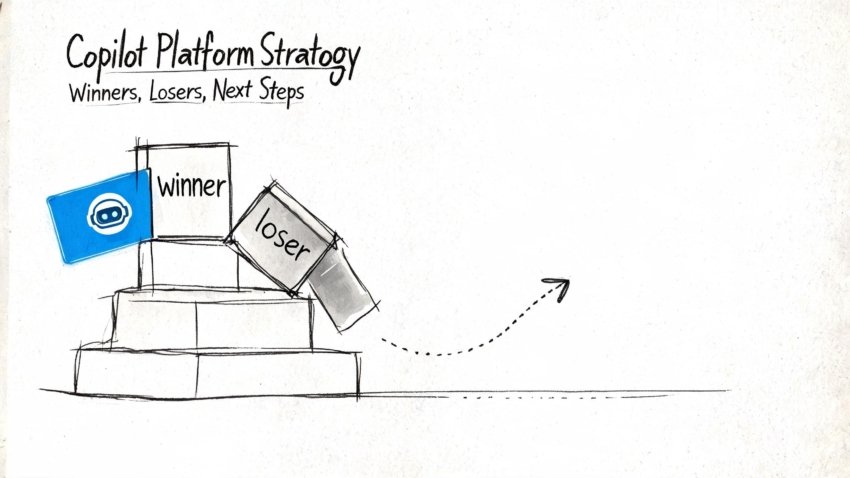
Copilot Platform Strategy: Winners, Losers, Next Steps
The Copilot Platform Strategy Shift That Will Reshape Developer Tool Budgets in 2026
TL;DR
GitHub moved the Copilot SDK to general availability across seven languages and expanded the Copilot desktop app preview with cross-repo agent orchestration, isolated Git worktrees, and a developer operations console. This is not a product update; it is a platform strategy that threatens standalone AI coding tool vendors, hands enterprise engineering teams a production-ready agent runtime already baked into their existing GitHub Copilot subscription, and expands Microsoft’s ownership of the developer workflow from the IDE into Teams, mobile, and the CLI.
Quick Takeaways
- The Copilot SDK reaching GA in Node.js, TypeScript, Python, Go, .NET, Rust, and Java makes custom agent development production-ready for enterprise teams on existing paid Copilot plans.
- The Copilot desktop app’s agent orchestration console, My Work view, and isolated Git worktree support reframe what a “developer productivity tool” actually does for team throughput.
- Standalone AI coding tool vendors such as Cursor and Tabnine face the same platform risk that standalone productivity apps face when an OS-level player bundles comparable functionality.
- Copilot Memory ties repository context to GitHub’s infrastructure; before committing internal automation to the SDK, procurement teams need a switching-cost analysis.
- The Teams integration, mobile extensions, and CLI expansion signal that Microsoft is converging all developer surfaces under a single Copilot control layer.
GitHub Copilot’s Shift from Coding Assistant to Agent Platform: What Changed Between 2025 and 2026
GitHub Copilot spent its first three years as an autocomplete engine with a chat interface. The gains were measurable, but the product was not a platform strategy.
The moves GitHub announced in mid-2025 and continued shipping through 2026 are fundamentally different. The Copilot SDK reaching general availability across Node.js, TypeScript, Python, Go, .NET, Rust, and Java means any engineering team on a paid Copilot plan can now build custom agents on the same runtime GitHub uses internally, production-grade and ready to ship against.
The Copilot desktop app preview has expanded into a developer operations console. It supports cross-repository agent sessions, isolated Git worktrees for parallel agents, and a My Work view that aggregates issues, pull requests, and notifications across every repository a developer touches. The app can now autonomously open and merge pull requests without the developer switching IDEs.
Taken together, the SDK GA and desktop app expansion complete a familiar platform playbook: build an extension ecosystem, centralize user workflow, then expand across every tool your customer already uses. GitHub is executing this on top of a repository host that already controls the version control layer for a majority of enterprise engineering teams.
Who Wins from the Copilot Platform Shift: Enterprise Engineering Teams, Platform Builders, and Microsoft
Enterprise engineering teams already on GitHub Copilot Business or Enterprise are the clearest winners. The same subscription now covers a production agent runtime, a standalone desktop app, Teams integration, and mobile extensions. Significant value expansion, no budget change.
Platform engineering teams gain a higher-level abstraction: agents that understand repository context natively, execute multi-step workflows, and orchestrate from a central console without custom middleware. Building a release-note generator, dependency audit agent, or issue triage system is now substantially cheaper in effort and complexity.
The second tier of winners is vendors building on the Copilot runtime. GitHub’s partner agent program is nascent but clear: third parties build specialized agents, GitHub hosts and distributes them, and teams discover them from within Copilot. Vendors who move first capture distribution that would otherwise cost significant sales and marketing investment.
Microsoft wins at the portfolio level. Every surface the Copilot control layer extends to deepens Microsoft’s developer workflow data advantage and raises switching costs for enterprise customers. The GitHub acquisition is now paying strategic dividends well beyond developer tooling revenue.
Who Loses Market Position: Standalone AI Coding Tool Vendors and Agent Platforms Without GitHub-Native Integration
Standalone AI coding assistants like Cursor and Tabnine face the sharpest competitive pressure. The enterprise AI coding assistant market is now being occupied, and the dynamic is asymmetric in GitHub’s favor on every dimension that matters to a CFO reviewing the tool budget.
GitHub does not need Copilot to win a head-to-head benchmark. It needs Copilot to be good enough that procurement asks why the organization pays for two AI coding tools when one is bundled with the GitHub seat. The bundling advantage is structural, not technical.
The second category under pressure is general-purpose agent platforms that lack GitHub-native hooks. Agent platforms that require custom integration work to understand a pull request, read repository history, or interact with GitHub Actions are at a structural disadvantage relative to an agent runtime that treats those resources as first-class primitives. Competing on agent quality alone is insufficient when the integration layer itself is the moat.
Did You Know?
The Copilot agent mode introduced in VS Code in early 2025 was the first public signal that GitHub was pivoting toward multi-step autonomous task execution rather than single-turn code suggestions. The SDK GA and desktop app expansion are the architectural continuation of that pivot, not a separate product line bolted on afterward.
GitHub Copilot SDK as an AppExchange-Style Platform: How the Agent Runtime Ecosystem Strategy Works
GitHub is building an AppExchange-style ecosystem by exposing a shared agent runtime through a stable GA SDK, inviting third parties to build on infrastructure they cannot easily replicate independently. When Salesforce launched AppExchange in 2005, every partner app made the platform stickier for the customer, and stickier customers attracted more partners. GitHub is replicating that flywheel at the agent layer.
The Copilot runtime handles agent orchestration, session management, memory, and repository context retrieval. The partner builds the domain-specific logic on top. This division of labor is attractive for partners (lower infrastructure cost) and strategically valuable for GitHub (deeper ecosystem coverage without GitHub’s engineering headcount scaling linearly).
For enterprise buyers, the partner ecosystem is a leading indicator of platform viability. A Copilot SDK with a rich catalog of partner agents for security scanning, compliance checking, or infrastructure-as-code generation is a materially different procurement case than one used only for internal tooling. Watch catalog volume over the next two quarters as the clearest signal of whether this platform bet is compounding.
The Copilot Desktop App as a Developer Operations Console: Agent Orchestration, Parallel Worktrees, and Team Throughput
The Copilot desktop app owns the workflow layer above any specific editor. A developer who uses Vim, VS Code, and JetBrains can run the same Copilot agent sessions from a single console regardless of which editor is active.
Isolated Git worktree support deserves attention from engineering managers. An agent in an isolated worktree can make substantial code changes in parallel without interfering with other agent sessions or the developer’s active branch. Community discussions around parallel agent sessions consistently surface the same use case: running an exploratory refactoring agent in one worktree while the developer works a separate feature in another, then merging whichever output passes review.
If a developer supervises two or three parallel agent sessions, the throughput math changes. The work is not fully autonomous; the developer still reviews, redirects, and merges. But the volume of code moving from draft to merged PR in a sprint increases without a proportional increase in headcount. Engineering managers should restructure sprint planning and code review capacity for parallel agent sessions now.
| Capability | GitHub Copilot (Agent Platform) | Standalone AI Coding Tools |
|---|---|---|
| Agent runtime | Shared, production-grade, SDK-exposed (GA) | Proprietary; typically no public SDK |
| Repository context (Memory) | Native, tied to GitHub infrastructure | Requires manual indexing or custom integration |
| Cross-repo orchestration | Built into desktop app | Limited or unavailable |
| Isolated Git worktrees | Supported in desktop app preview | Not standard |
| SDK language support | Node.js, TypeScript, Python, Go, .NET, Rust, Java | Varies; typically no public SDK |
| Teams and mobile integration | Preview available via Microsoft ecosystem | Minimal or none |
| Incremental cost for enterprise | Included in existing Copilot Business/Enterprise seat | Separate subscription required |
Copilot Memory and SDK Lock-In: Vendor Risk Factors Enterprise Teams Must Assess Before Committing
Copilot Memory and the shared agent runtime create two compounding lock-in risks. Copilot Memory is the clearest: when an agent session learns a repository’s conventions and domain vocabulary and stores that context in GitHub’s infrastructure, it is not portable. Switching agent platforms means starting context-building from zero after the team has already reorganized workflows around memory-aware sessions.
The shared agent runtime compounds this. Internal automation built on the SDK uses GitHub-specific primitives for repository access, pull request creation, and workflow triggering. Migrating is not a configuration change; it is a rebuild. The more tooling a team ships on the SDK, the higher the exit cost each quarter.
None of this means avoid the SDK. Productivity gains are real and incremental cost is zero for paid plans. But SDK adoption warrants the same vendor risk framework as any strategic infrastructure dependency: document what you are building, model migration cost, and get explicit executive sign-off rather than letting adoption happen through individual team momentum.
Did You Know?
The Copilot-powered GitHub app for Microsoft Teams lets developers receive pull request status updates, assign tasks to colleagues, and trigger Copilot actions directly from a Teams message thread. For organizations where engineering and product conversations live in Teams rather than Slack, this integration reduces context switching without adding a new tool or budget line.
Microsoft’s Unified Copilot Control Layer: How Teams, Mobile, CLI, and Desktop Converge Developer Workflows
Microsoft is building a unified Copilot control layer across four surfaces: the desktop app, Teams integration, mobile extensions, and CLI expansion. The goal is to intercept the developer workflow at every context switch: editor to collaboration tool, collaboration tool to mobile notification, mobile notification back to terminal.
Each surface integration adds signal. When a developer responds to a pull request comment in Teams, Copilot records that interaction and surfaces it in the next desktop agent session. When a developer acknowledges an issue on mobile, that context is available to the next agent run. Accumulated context compounds with each integration point.
For technology buyers, this convergence changes the question. It is no longer “which AI coding assistant should we standardize on?” It is “how deeply do we want to integrate our engineering workflow into the Microsoft developer ecosystem, and what does that buy us versus cost us in optionality?” That has board-level implications in organizations where software development is a core competitive capability.
How to Act on the Copilot Platform Shift: Steps for the Next 30 to 90 Days
The Copilot SDK is GA and the desktop app is in expanded preview. Here is what enterprise technology leaders should do in the next 30 to 90 days.
Audit your AI developer tool spend. Map every AI coding tool subscription against what the existing GitHub Copilot Business or Enterprise seat now covers. Agent orchestration, cross-repo context, and standalone desktop tooling are areas where Copilot has recently extended. Quantify redundancy before the next budget cycle.
Brief procurement and legal on SDK lock-in risk before any team ships automation on it. Document which internal tools would be built on the SDK, what a migration would require, and whether the efficiency gains justify the dependency. This is not a reason to avoid the SDK; it is a reason to adopt deliberately rather than by default.
Run a bounded SDK spike on one high-volume repetitive task. Release-note generation, dependency auditing, and issue triage are strong candidates: ROI is measurable, build effort is bounded to a sprint or two, and output is reviewable by non-engineers. Ship one agent, measure time savings against a baseline, and present results as data when requesting broader investment.
Enroll in the Teams integration preview if your engineering conversations live in Teams. Getting ahead of it means you shape adoption rather than react after behavior has shifted. Understand how pull-request-at-mention and task-assignment-via-Teams change your existing ticketing and standup rituals before confusion sets in at scale.
Push the desktop app preview to engineering managers and senior developers on paid Copilot plans today. Frame it as a no-cost trial and ask participants to capture which session types deliver the clearest time savings. That data grounds your next SDK investment decision in actual workflows rather than vendor benchmarks.
The Copilot Agent Platform: What Enterprise Technology Leaders Should Decide Now
GitHub has made the most consequential structural change to Copilot since launch: the shift from a coding assistant to a full agent platform with a production SDK, a developer operations console, and a cross-surface expansion strategy that touches Teams, mobile, and the CLI. For enterprise engineering organizations, the productivity opportunity is real and the incremental cost is zero for teams already on paid plans.
The risks are equally real. Copilot Memory and the shared agent runtime create switching costs that compound with each internal automation project. Standalone vendors under pressure will respond with their own platform expansions, so the competitive landscape will look different in 12 months. Adopt selectively, measure rigorously, and avoid the reflex to either dismiss the platform as hype or commit wholesale before the lock-in implications are scoped. That window is open right now.